 书单
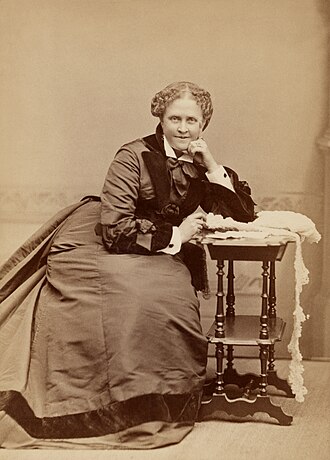
海伦·亨特·杰克逊
- 生卒
- 1830 – 1885
- 国籍
- 美国
- 外文名
- Helen Hunt Jackson
照片:Charles F. Conly / Adam Cuerden,公有领域,来自维基共享资源「Helen Hunt Jackson by Charles F. Conly.jpg」(经缩小)。
生平与创作
这个词条暂时没有中文维基百科条目,下面是英文维基百科的内容(英文原文):
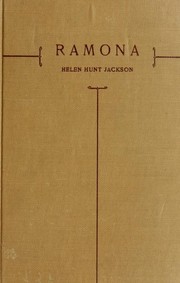
Helen Hunt Jackson (pen name: H.H.; born Helen Maria Fiske; October 15, 1830 – August 12, 1885) was an American poet and writer who became an activist for improved treatment of Native Americans by the United States government. She described the adverse effects of government actions in her history A Century of Dishonor (1881). Her popular novel Ramona (1884) dramatized the federal government's mistreatment of Native Americans in Southern California after the Mexican–American War and attracted considerable attention to her cause. Commercially successful, it was estimated to have been reprinted 300 times, with readers liking its romantic and picturesque qualities more than its political content. The novel was so popular that it attracted many tourists to Southern California who wanted to see places from the book.
Early life and education
Helen Maria Fiske was born in Amherst, Massachusetts, the daughter of Nathan Welby Fiske and Deborah Waterman Vinal Fiske. Her father was a minister, author, and professor of Latin, Greek, and philosophy at Amherst College. Two brothers, Humphrey Washburn Fiske (?–1833) and David Vinal Fiske (1829–1829), died soon after birth. There was also a sister, Anne. The children were raised as Unitarians. Anne became the wife of E. C. Banfield, a federal government official who served as Solicitor of the United States Treasury.
The mother died from consumption in 1844, when Fiske was fourteen. Three years later, the father died. He had provided financially for Fiske's education and arranged for an uncle to care for her. Fiske attended Ipswich Female Seminary and the Abbott Institute, a boarding school in New York City run by Reverend John Stevens Cabot Abbott. She was a classmate of Emily Dickinson, also from Amherst; the two corresponded for the rest of their lives, but few of their letters survived.
Career
Marriage, family, and early writing career
In 1852, she married U.S. Army Captain Edward Bissell Hunt. They had two sons, one of whom, Murray Hunt (1853–1854), died as an infant in 1854 of a brain disease. Her husband died in October 1863, in an accident that occurred while he was experimenting with one of his marine inventions. Her second son, Warren "Rennie" Horsford Hunt (born 1855) died of diphtheria in 1865 at the age of nine. Most of Hunt's early elegiac verse grew out of this heavy experience of loss and sorrow. Up to this time, her life had been absorbed in domestic and social duties. Her real literary career began when she removed herself to Newport in the winter of 1866. Her first successful poem, "Coronation", appeared in The Atlantic three years later. It was the commencement of a long and fruitful connection with that magazine, with The Century later, and with The Nation and Independent. The years 1868–1870 were spent in Europe, in travel and literary work. In 1872, she visited California for the first time.
In the winter of 1873–1874, she was in Colorado Springs, Colorado at the resort of Seven Falls, seeking rest in hopes of a cure for tuberculosis, which was often fatal before the invention of antibiotics. While in Colorado Springs, Hunt met William Sharpless Jackson, a wealthy banker and railroad executive. They married in 1875, and she took the name Jackson, under which she was best known for her later writings. She published her early work anonymously, usually under the name "H.H." Ralph Waldo Emerson admired her poetry and used several of her poems in his public readings. He included five of them in his Parnassus: An Anthology of Poetry (1880).
Over the next two years, she published three novels in the anonymous No Name Series, including Mercy Philbrick's Choice and Hetty's Strange History. She also encouraged a contribution from Emily Dickinson to A Masque of Poets as part of the same series.
Activist for Native Americans
In 1879, Jackson's interests turned to Native Americans after she heard a lecture in Boston by Chief Standing Bear, of the Ponca Tribe. Standing Bear described the forcible removal of the Ponca from their Nebraska reservation and transfer to the Quapaw Reservation in Indian Territory (Oklahoma), where they suffered from disease, harsh climate, and poor supplies. Upset about the mistreatment of Native Americans by government agents, Jackson became an activist on their behalf. She started investigating and publicizing government misconduct, circulating petitions, raising money, and writing letters to The New York Times on behalf of the Ponca.
A fiery and prolific writer, Jackson engaged in heated exchanges with federal officials over the injustices committed against the Ponca and other American Indian tribes. Among her special targets was U.S. Secretary of the Interior Carl Schurz, whom she once called "the most adroit liar I ever knew." She exposed the government's violation of treaties with American Indian tribes. She documented the corruption of US Indian agents, military officers, and settlers who encroached on and stole reserved Indian lands. Jackson won the support of several newspaper editors who published her reports. Among her correspondents were editor William Hayes Ward of the New York Independent, Richard Watson Gilder of The Century Magazine, and publisher Whitelaw Reid of the New York Daily Tribune.
A Century of Dishonor
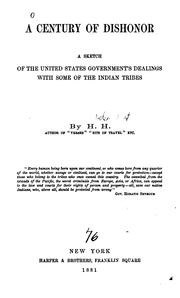
In 1879, Jackson attended a lecture by Standing Bear about the creation of the Great Sioux Reservation in 1868. In response, Jackson wrote a book, originally published with her H. H. pseudonym but then in 1885 reprinted under her own name Helen Jackson, in which she condemned state and federal Indian policies. She recounted a history of broken treaties. A Century of Dishonor (1881) called for significant reform in government policy toward Native Americans. Jackson sent a copy to every member of Congress with a quote from Benjamin Franklin printed in red on the cover: "Look upon your hands: they are stained with the blood of your relations." The New York Times, however, suggested the following in Jackson's obituary:
以上文字摘自英文维基百科「Helen Hunt Jackson」(有删节,去掉了参考文献等尾部小节),按 CC BY-SA 4.0 使用,作者为维基百科的各位编者。
资料卡
- 本名
- Helen Maria Fiske
- 笔名
- H.H
- 出生
- 1830 年 10 月 15 日
- 出生地
- 阿姆赫斯特
- 逝世
- 1885 年 8 月 12 日
- 逝世地
- 旧金山
- 职业
- 新闻工作者、小说家、作家、诗人
- 使用语言
- 英语
- 写作语言
- 英语
- 代表作
- A Century of Dishonor
- 获奖
- 科罗拉多州女性名人堂(1985)
资料卡来自 Wikidata Q462363(CC0),众包数据,个别字段可能不全。
本站收录的作品(2)
作品年表(2 本)
本站书库里署名海伦·亨特·杰克逊的书(Open Library 上至少 10 人加过书架的才收),按首版年份排(有本站书页的用 Wikidata 记的首版年,其余用 Open Library 的);年份偶尔记成后来的版本或译本,以原书为准。全部作品见 Open Library。
- 1881A Century Of Dishonor书架 15
- 1884Ramona书架 18