书单
百科
这个词条暂时没有中文维基百科条目,下面是英文维基百科的内容(英文原文):
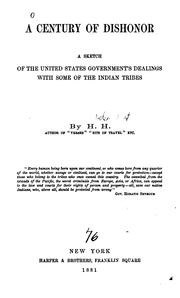
A Century of Dishonor: A Sketch of the United States Government's Dealings with Some of the Indian Tribes is a non-fiction book by Helen Hunt Jackson first published in 1881 that chronicled the experiences of Native Americans in the United States, focusing on injustices.
Jackson wrote A Century of Dishonor in an attempt to change government ideas and policy toward Native Americans at a time when the effects of the 1871 Indian Appropriations Act (making the entire Native American population wards of the nation) had begun to draw the attention of the public. Jackson attended a meeting in Boston in 1879 at which Standing Bear, a Ponca, told how the federal government forcibly removed his tribe from their ancestral homeland in the wake of the creation of the Great Sioux Reservation. After meeting Standing Bear, she conducted research at the Astor Library in New York and was shocked by the story of government mistreatment that she found. She wrote in a letter, "I shall be found with 'Indians' engraved on my brain when I am dead.—A fire has been kindled within me which will never go out."
Jackson sent a copy of her book to every member of Congress, at her own expense. She hoped to awaken the conscience of the American people, and their representatives, to the flagrant wrongs that had been done to the American Indians, and persuade them "to redeem the name of the United States from the stain of a century of dishonor".
The book consists primarily of the tribal histories of seven different tribes. Among the incidents it depicts is the eradication of Praying Town Indians in the colonial period, despite their recent conversion to Christianity, because it was assumed that all Indians were the same. Her book brought to light the injustices enacted upon the Native Americans as it chronicled the ruthlessness of white settlers in their greed for land, wealth, and power.
Upon its publication, A Century of Dishonor received some adverse criticism and was dismissed as "sentimental". But it had some effect in shaking the moral senses of America, and in 1881 Congress acted to remedy, in part, the situation of the Ponca people. However, it did not have quite the impact that Jackson wanted, which spurred her to write an emotional appeal to action in Ramona.
Long out of print, A Century of Dishonor was first reprinted in 1964 by Ross & Haines of Minneapolis, Minnesota, via a limited printing of 2,000 copies, and has been reprinted numerous times since then.
Synopsis
Originally published in 1881, Helen Hunt Jackson chronicles the treatment of American Indians by the United States beginning in colonial times through to her present. The book can be broken down into four major themes:
the mistreatment of seven major Native American tribes promises and treaties issued and broken by the United States government to these tribes forced removal of these (and other) tribes to reservations located on land that was unsuitable for farming or sustaining the Native American way of life massacres of the Native American people by white Americans.
Jackson begins by providing in her "Introductory" a summary of the policies and positions of the United States relative to the Native American population; however, because of the time in which she was writing, she refers to them as Indians. Jackson calls attention to the changes that occurred when the United States took territory from the colonial powers. Most prominently, the United States did not acknowledge or respect Native claims to the land, as recognized by treaties, to the same degree that Spain, Britain, and France had. This was in part, she explains, because the treaties written in English purposefully had different expectations than those written for and signed by the Native populations. She contextualizes her distress by examining the attitudes of the legislature, the executive, and the judiciary from the end of the 18th century through much of the 19th century. She concludes by stating that through their unjust treatment of Native Americans, the United States violated international law and made itself susceptible to a reputation for cruelty.
The Peoples
The seven chapters that follow the introduction each describe the general history of the Delaware, the Cheyenne, the Nez Percé, the Sioux, the Ponca, the Winnebagoes, and the Cherokee, as well as the way their cultures shaped the way the United States took advantage of them. Jackson uses evidence from Official Reports of the War Department or the Department of Interior to show that the United States did not hide the atrocities they committed, nor did they see them as such. In addition to using evidence that the United States provided of their mistreatment of Native Americans, Jackson also took great care to ensure that she included information on how each of the people viewed themselves and how they felt about the way they were treated. For example, at the beginning of her chapter on the Sioux, she provides a history of their name (it comes from the old French word Nadouessioux meaning enemies) but also includes that they refer to themselves as "Dakota".
Massacres
Having shared the legal and cultural trouble that the aforementioned tribes experienced at the hands of the United States, Jackson goes on to provide detailed descriptions of three massacres: The Conestoga Massacre, the Gnadenhütten Massacre, and the Massacres of Apaches, as a demonstration of the violence committed against Native Americans. In addition to explaining the atrocities and violence, Jackson also provides a history of the interactions between the Native Americans and the white population prior to the massacres.
以上文字摘自英文维基百科「A Century of Dishonor」(有删节,去掉了参考文献等尾部小节),按 CC BY-SA 4.0 使用,作者为维基百科的各位编者。
资料卡
- 原题
- A Century of Dishonor
- 原作语言
- 英语
- 体裁
- 非虚构作品
资料卡来自 Wikidata Q4655785(CC0),众包数据,个别字段可能不全。