 书单
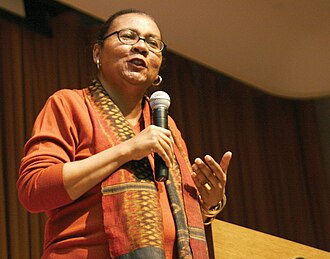
贝尔·胡克斯
- 生卒
- 1952 – 2021
- 国籍
- 美国
- 外文名
- bell hooks
照片:Cmongirl,公有领域,来自维基共享资源「Bellhooks.jpg」(经缩小)。
生平与创作
葛劳瑞亚·珍·沃特金(英语:Gloria Jean Watkins,1952年9月25日—2021年12月15日)以笔名贝尔·胡克斯(bell hooks)而为人所知。是一位美国作家、教授、女权主义者和活动家。贝尔·胡克斯这个笔名取自她非常钦佩的外曾祖母Bell Blair Hooks,为了与外曾祖母区分,她的笔名都使用小写字母。
生平
胡克斯写作的重点是分析种族、资本主义和社会性别的交叉性,以及她所描述的他们产生和延续压迫和阶级统治体系的能力。她出版了30多本书和许多学术文章,也出现在纪录片中,并经常举办公开讲座。她在教育、艺术、历史、性、大众传媒和女性主义等方面探讨过种族、阶级和性别问题。
2014年,她在肯塔基州伯里亚的伯里亚学院创办了贝尔·胡克斯研究所。
以上文字摘自维基百科「贝尔·胡克斯」(去掉了参考文献等尾部小节),按 CC BY-SA 4.0 使用,作者为维基百科的各位编者。
中文维基百科的条目比较短,下面附上英文维基百科的内容(英文原文):
Gloria Jean Watkins (September 25, 1952 – December 15, 2021), better known by her pen name bell hooks (stylized in lowercase), was an American philosopher, educator, author, and social critic; she was a Distinguished Professor in Residence at Berea College in Kentucky. Professor hooks wrote about race, feminism, and social class. Her work explored the intersections of race, capitalism, and gender, and what she described as their ability to produce and perpetuate systems of oppression and class domination. Her work served as foundational to the modern idea of intersectionality. She published numerous scholarly articles and nearly 40 books, in styles ranging from essays and poetry to children's literature, with a body of work that addressed love, gender, art, history, sexuality, and mass media.
hooks began her academic career in 1976 teaching English and ethnic studies at the University of Southern California. She later taught at several institutions including Stanford University (as a guest-lecturer), Yale University, New College of Florida, and The City College of New York, before joining Berea College in Berea, Kentucky, in 2004. In 2014, hooks also founded the bell hooks Institute at Berea College. Her pen name was borrowed from her maternal great-grandmother, Bell Blair Hooks, using lowercase to decenter herself and instead maintain focus on the substance of her writings.
Early life
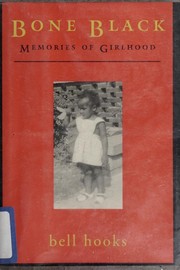
Gloria Jean Watkins was born on September 25, 1952, to a working-class African-American family, in Hopkinsville, a small, segregated town in Kentucky. hooks was one of six children born to Rosa Bell Watkins (née Oldham) and Veodis Watkins. Her father worked as a janitor and her mother worked as a maid in the homes of white families. In her memoir Bone Black: Memories of Girlhood (1996), hooks would write of her "struggle to create self and identity" while growing up in "a rich magical world of southern black culture that was sometimes paradisiacal and at other times terrifying."
An avid reader (with poets William Wordsworth, Langston Hughes, Elizabeth Barrett Browning and Gwendolyn Brooks among her favorites), hooks was educated in racially segregated public schools, later moving to an integrated school in the late 1960s. This experience greatly influenced her perspective as an educator, and it inspired scholarship on education practices as seen in her book, Teaching to Transgress: Education as the Practice of Freedom. She graduated from Hopkinsville High School before obtaining her B.A. in English from Stanford University in 1973, and her M.A. in English from the University of Wisconsin–Madison in 1976. During this time, hooks was writing her book Ain't I a Woman: Black Women and Feminism, which she began writing at the age of 19 (c.1971) and then published (as bell hooks) in 1981.
In 1983, after several years of teaching and writing, hooks completed her doctorate in literature at the University of California, Santa Cruz, with a dissertation on author Toni Morrison entitled "Keeping a Hold on Life: Reading Toni Morrison's Fiction".
Influences
Among hooks' influences is the American abolitionist and feminist Sojourner Truth. Truth's "Ain't I a Woman?" inspired hooks's first major book. The Brazilian educator Paulo Freire is mentioned in hooks's book Teaching to Transgress. His perspectives on education are present in the first chapter, "engaged pedagogy". Other influences include Peruvian theologian Gustavo Gutiérrez, psychologist Erich Fromm, playwright Lorraine Hansberry, Buddhist monk Thích Nhất Hạnh, and African American writer James Baldwin.
Frantz Fanon's The Wretched of the Earth was a powerful inspiration for hooks and her approach to the decolonial struggle.
以上文字摘自英文维基百科「Bell hooks」(有删节,去掉了参考文献等尾部小节),按 CC BY-SA 4.0 使用,作者为维基百科的各位编者。
资料卡
- 本名
- Gloria Jean Watkins
- 笔名
- bell hooks
- 出生
- 1952 年 9 月 25 日
- 出生地
- 霍普金斯
- 逝世
- 2021 年 12 月 15 日
- 逝世地
- 伯里亚
- 职业
- 哲学家、大学教师、作家、非虚构文学作家、文学学者
- 使用语言
- 美国英语、英语
- 就读学校
- 斯坦福大学(1973)、Hopkinsville High School、圣克鲁斯加利福尼亚大学、威斯康星大学麦迪逊分校
- 领域
- 性别研究、批判种族理论、文化批评、大众文化、族裔 等 9 项
- 受谁影响
- 索杰纳·特鲁思、保罗·弗莱雷、古斯塔沃·古铁雷斯、埃里希·弗罗姆、洛兰·汉斯贝里、释一行、詹姆斯·鲍德温、马尔科姆·X、马丁·路德·金、托妮·莫里森
- 代表作
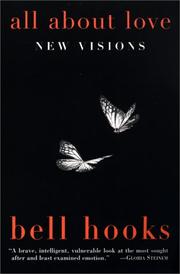
- Ain't I a Woman?、All About Love: New Visions、We Real Cool: Black Men and Masculinity、Feminist Theory: From Margin to Center、Bone Black: Memories of Girlhood
- 获奖
- 美国图书奖(1991)
资料卡来自 Wikidata Q259507(CC0),众包数据,个别字段可能不全。
本站收录的作品(4)
影响过 Ta 的作家
同时代的美国作家
Open Library 上的全部作品
正在读取…