 书单
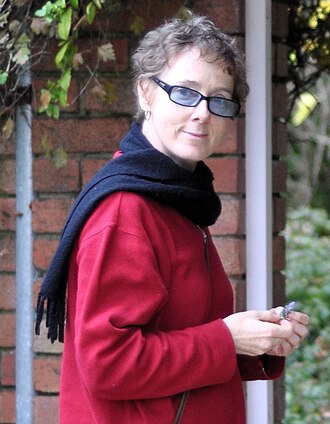
Donna Williams
- 生卒
- 1963 – 2017
- 国籍
- 澳大利亚
照片:Chris Samuel,CC BY 2.0,来自维基共享资源「DonnaWilliams2011.jpg」(经缩小)。
生平与创作
这个词条暂时没有中文维基百科条目,下面是英文维基百科的内容(英文原文):
Donna Leanne Williams (born Donna Keene; 12 October 1963 – 22 April 2017), also known by her married name Donna Leanne Samuel and as Polly Samuel, was an Australian writer, artist, singer-songwriter, screenwriter, and sculptor.
In 1965, aged two, Williams was assessed as "psychotic". During the rest of her childhood, she was tested multiple times for deafness and labelled as "disturbed". In 1991, she was diagnosed as autistic and also underwent treatment for gut, immune system and sensory perceptual disorders. She wrote four memoirs: Nobody Nowhere: The Extraordinary Autobiography of an Autistic Girl (1992), Somebody Somewhere: Breaking Free from the World of Autism (1994), Like Colour to the Blind: Soul Searching and Soul Finding (1998) and Everyday Heaven: Journeys Beyond the Stereotypes of Autism (2004) – and released two albums, Nobody Nowhere and Mutation. She was the subject of several TV documentaries during the '90s.
Williams wrote textbooks on the autism spectrum and was a qualified teacher, international public speaker and autism consultant.
Williams died of cancer in April 2017.
Early life and education
Donna Leanne Williams was born Donna Keene in October 1963. She grew up in Melbourne with an older brother, James, and a younger brother, Tom Williams (the street artist Duel; born 1969). The name Donna was chosen by her mother; however, her father called her Polly, the name she most identified with, and she legally changed her name to Polly in 2015.
According to the New York Times review of Williams's first book, her earliest memories included "rubbing her eyes furiously to lose herself in 'bright spots of fluffy color', which she found a soothing refuge against the 'intrusive gabble' of the human world around her". Her father, Ellis John Keene, later known as Jack Williams (1936–1995), was bipolar and aloof, while her mother was an alcoholic who was physically and emotionally abusive.
In 1965, at the age of two, Williams was assessed as a psychotic infant; subsequently, throughout her childhood, she was tested multiple times for deafness and labelled as "disturbed". Williams alleged on her blog that she had been sexually assaulted by comedian Barry Humphries at the age of eight during a party held by her father. By the age of nine, she had developed two alternate personalities: "Willie", her "rebellious, disruptive, and bad-mannered side" and "Carol", the "kind, polite, socially acceptable child". That year, she was also diagnosed with various dietary conditions including "milk allergies, dairy [and] gluten intolerances[; and] salicylate intolerance" and was placed on a multivitamin and zinc regime. At fifteen, Williams left home and worked in various jobs but struggled to support herself. At times she was homeless, passing from boyfriend to boyfriend while suffering "gross cruelty and domestic prostitution in relationships with men".
With the help of a psychiatric social worker, Williams finished secondary education and enrolled in tertiary studies. From 1982, Williams started studying at La Trobe University and eventually graduated with a Bachelor of Arts and Diploma of Education in 1990.
Autism
In 1991, Williams was diagnosed with autism by Lawrence Bartak, a specialist at Monash Medical Centre and a senior lecturer in psychology at the associated Monash University. Bartak later recalled "[Williams] displayed all the main features of autism when I met her, including one she wouldn't have known about ... The fact that she was apparently sociable and interacting with people doesn't mean she didn't have some type of disorder". Bartak helped Williams "begin building bridges instead of walls between worlds". In July 1996, doubts about Williams's condition were aired on Radio National's The Health Report and by The Australian newspaper. The claims of "faking it" were denied by both Williams and Bartak. In February 2005, David Smukler, writing in the American Association on Intellectual and Developmental Disabilities' journal Mental Retardation, noted that back in the mid-1990s some sceptics had a poorly defined understanding of the autism spectrum: "...autistic people such as Donna Williams and Temple Grandin started to publish first-person accounts that described their lives as autistic people living in an often-inhospitable nonautistic world. Many readers of these early accounts questioned whether or not the authors were really autistic. The assumption underlying such responses is that autism is so incapacitating that Williams or Grandin could not be autistic and still write with such insight and sensitivity. When their books first appeared, autistic authors were characterized either as frauds or exceptions". Smukler concluded: "Today, Williams' and Grandin's 'credentials' are rarely challenged. Rather than being doubted, they are more likely to be commended for offering us an 'inside out' view of autism".
Career
By 1992, Williams was a qualified teacher. Subsequently, she became an international public speaker and an autism consultant. In 2002, she joined the United Kingdom's Medical Research Council's review into the causes of autism, where she was appointed to the lay-person's panel.
Work
Books
In 1992, Williams published her first book, an autobiographical account titled Nobody Nowhere: The Extraordinary Autobiography of an Autistic Girl (Doubleday, London). It was an international best seller including spending fifteen weeks on The New York Times Best Seller list for adult non-fiction in 1993. It was short-listed for the New South Wales Premier's Literary Awards for non-fiction in 1992. According to Kirkus Reviews the book enabled people associated with autistic individuals, to "understand more clearly what those unresponsive 'dead eyes' see". While Daniel Goleman of The New York Times described how Williams "originally wrote it as a series of notes to herself, to help her make sense of her own chaotic world. She planned to burn her journal until a therapist helped her see the value in sharing it".
以上文字摘自英文维基百科「Donna Williams」(有删节,去掉了参考文献等尾部小节),按 CC BY-SA 4.0 使用,作者为维基百科的各位编者。
资料卡
- 本名
- Donna Keene
- 出生
- 1963 年 10 月 12 日
- 出生地
- 墨尔本
- 逝世
- 2017 年 4 月 22 日
- 逝世地
- Ringwood East
- 职业
- 作家、创作歌手、编剧、歌手、自传作者、雕塑家、艺术家、画家 等 11 项
- 使用语言
- 英语
- 就读学校
- 蒙纳士大学(2004)
- 文学运动 / 流派
- 表现主义
- 领域
- 作曲、绘画、雕塑艺术
- 代表作
- Nobody Nowhere、Somebody Somewhere、Like Colour to the Blind
资料卡来自 Wikidata Q441389(CC0),众包数据,个别字段可能不全。
本站收录的作品(1)
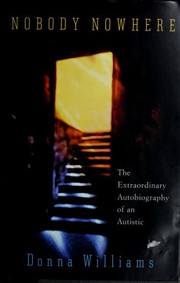
作品年表(2 本)
本站书库里署名Donna Williams的书(Open Library 上至少 10 人加过书架的才收),按首版年份排(有本站书页的用 Wikidata 记的首版年,其余用 Open Library 的);年份偶尔记成后来的版本或译本,以原书为准。全部作品见 Open Library。
- 1992Nobody Nowhere书架 94
- 1994Somebody somewhere书架 11