 书单
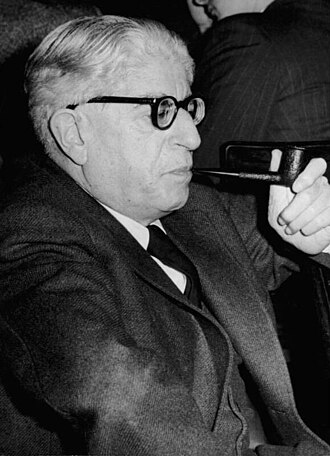
恩斯特·西蒙·布洛赫
- 生卒
- 1885 – 1977
- 国籍
- 德国、瑞士
- 外文名
- Ernst Bloch
照片:Krueger,CC BY-SA 3.0 de,来自维基共享资源「Bundesarchiv Bild 183-35545-0009, Berlin, Ernst Bloch auf 15. Schriftstellerkongress.jpg」(经缩小)。
生平与创作
恩斯特·布洛赫(德语:Ernst Bloch,1885年7月8日—1977年8月4日),德国马克思主义哲学家、散文家,新马克思主义代表人物,一说属新马克思主义之一的早期西方马克思主义代表人物。主要著作包括《希望的原理》(德语:Das Prinzip Hoffnung)、《乌托邦精神》(德语:Geist der Utopie)等,受黑格尔和卡尔·马克思以及托马斯·闵采尔、帕拉塞尔苏斯和雅各·波墨等人影响,代表理论贡献包括希望哲学理论等。
以上文字摘自维基百科「恩斯特·布洛赫」(去掉了参考文献等尾部小节),按 CC BY-SA 4.0 使用,作者为维基百科的各位编者。
中文维基百科的条目比较短,下面附上英文维基百科的内容(英文原文):
Ernst Simon Bloch (German: [ɛʁnst ˈblɔx]; 8 July 1885 – 4 August 1977) was a German Marxist philosopher. Bloch was influenced by Georg Wilhelm Friedrich Hegel and Karl Marx, as well as by apocalyptic and religious thinkers such as Thomas Müntzer, Paracelsus, and Jacob Böhme. He established friendships with György Lukács, Bertolt Brecht, Kurt Weill, Walter Benjamin, and Theodor W. Adorno. Bloch's work focuses on an optimistic teleology of the history of mankind.
Life
Bloch was born in Ludwigshafen, the son of a Jewish railway employee. After studying philosophy, he married Else von Stritzky, daughter of a Baltic brewer in 1913, who died in 1921. His second marriage with Linda Oppenheimer lasted only a few years. His third wife was Karola Piotrowska, a Polish architect, whom he married in 1934 in Vienna. When the Nazis came to power, the couple had to flee, first to Switzerland, then to Austria, France, Czechoslovakia, and finally to the United States. He lived briefly in New Hampshire before settling in Cambridge, Massachusetts. It was there, in the reading room of Harvard's Widener Library, that Bloch wrote the lengthy three-volume work The Principle of Hope. He originally planned to publish it there under the title Dreams of a Better Life.
In 1948, Bloch was offered the chair of philosophy at Leipzig University, and he returned to East Germany to take up the position. In 1955, he was awarded the National Prize of the GDR. Additionally, he became a member of the German Academy of Sciences at Berlin (AdW). He had more or less become the political philosopher of the GDR. Among his many academic students from this period was his assistant Manfred Buhr, who earned his doctorate with him in 1957, and was later a professor in Greifswald, then director of the Central Institute of Philosophy of the Academy of Sciences (ADC) in Berlin and who became a critic of Bloch.
However, the Hungarian uprising in 1956 led Bloch to revise his view of the SED (Socialist Unity Party) regime, whilst retaining his Marxist orientation. Because he advocated humanistic ideas of freedom, he was obliged to retire in 1957 for political reasons – not because of his age, 72 years. A number of scientists and students spoke publicly against this forced retirement, among them the renowned professor and colleague Emil Fuchs and his students as well as Fuchs's grandson Klaus Fuchs-Kittowski.
When the Berlin Wall was built in 1961, he did not return to the GDR, but went to Tübingen in West Germany, where he received an honorary chair in Philosophy. He engaged with a Christian-Marxist intellectual dialogue group organized by Milan Machovec and others in the Czechoslovakia of the 1960s. He died in Tübingen.
Thought
Bloch was a highly original and eccentric thinker. Much of his writing—in particular, his magnum opus The Principle of Hope—is written in a poetic, aphoristic style. The Principle of Hope tries to provide an encyclopedic account of mankind's and nature's orientation towards a socially and technologically improved future. This orientation is part of Bloch's overarching philosophy. Bloch believed the universe is undergoing a transition from its primordial cause (Urgrund) toward its final goal (Endziel). He believed this transition is effected through a subject-object dialectic, and he saw evidence for this process in all aspects of human history and culture.
Influence
Bloch's work became influential in the course of the student protest movements in 1968 and in liberation theology. It is cited as a key influence by Jürgen Moltmann in his Theology of Hope (1967, Harper and Row, New York), by Dorothee Sölle, and by Ernesto Balducci. Psychoanalyst Joel Kovel has praised Bloch as, "the greatest of modern utopian thinkers". Robert S. Corrington has been influenced by Bloch, though he has tried to adapt Bloch's ideas to serve a liberal rather than a Marxist politics.
以上文字摘自英文维基百科「Ernst Bloch」(有删节,去掉了参考文献等尾部小节),按 CC BY-SA 4.0 使用,作者为维基百科的各位编者。
资料卡
- 母语名
- Ernst Bloch
- 出生
- 1885 年 7 月 8 日
- 出生地
- 路德维希港
- 逝世
- 1977 年 8 月 4 日
- 逝世地
- 蒂宾根
- 职业
- 哲学家、大学教师、神学家
- 使用语言
- 德语
- 写作语言
- 德语
- 就读学校
- 维尔茨堡大学、慕尼黑大学
- 文学运动 / 流派
- 表现主义
- 领域
- 哲学
- 所属团体
- 东德科学院
- 配偶
- Karola Bloch(1934)、Else Bloch-von Stritzky
- 受谁影响
- 格奥尔格·威廉·弗里德里希·黑格尔、路德维希·费尔巴哈、卡尔·马克思、卡尔·迈、格奥尔格·齐美尔、马克斯·韦伯、列宁、捷尔吉·卢卡奇、贝尔托·布莱希特、寇特·威尔 等 11 项
- 代表作
- 希望的原理、Atheism in Christianity、The Spirit of Utopia
- 获奖
- 东德国家奖、德国书商和平奖(1967);另有 4 项只有外文名
资料卡来自 Wikidata Q57240(CC0),众包数据,个别字段可能不全。
本站收录的作品(2)
影响过 Ta 的作家
同时代的德国作家
同一流派:表现主义
Open Library 上的全部作品
正在读取…