 书单
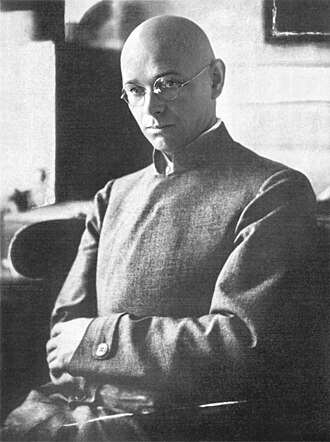
约翰内斯·伊顿
- 生卒
- 1888 – 1967
- 国籍
- 瑞士
- 外文名
- Johannes Itten
照片:MagentaGreen(衍生作品),CC BY-SA 3.0,来自维基共享资源「Johannes Itten (retuschiert).jpg」(经缩小)。
生平与创作
约翰内斯·伊顿(德语:Johannes Itten,1888年11月11日—1967年3月25日),瑞士表现主义画家、设计师、教师、作家和理论家;与德裔美籍画家莱昂内尔·费宁格和德国雕塑家格哈德·马克斯,在德国建筑师瓦尔特·格罗皮乌斯的领导下,为魏玛包豪斯的核心成员。
生平
他受阿道夫·赫尔策尔和弗朗茨·奇热克影响甚深。
1919年至1922年间,伊顿任教于包豪斯,负责“形态课程”,指导学生素材特性、组成与色彩等基础。1920年,他延揽保罗·克利和格奥尔格·穆赫加入包豪斯。同年他出版著作《色彩论》,阐述他对阿道夫·霍尔茨尔色环理论的推衍,提出包含12色的“色环”。
以上文字摘自维基百科「约翰内斯·伊顿」(去掉了参考文献等尾部小节),按 CC BY-SA 4.0 使用,作者为维基百科的各位编者。
中文维基百科的条目比较短,下面附上英文维基百科的内容(英文原文):
Johannes Itten (11 November 1888 – 25 March 1967) was a Swiss expressionist painter, designer, teacher, writer and theorist associated with the Bauhaus (Staatliches Bauhaus) school. Together with German-American painter Lyonel Feininger and German sculptor Gerhard Marcks, under the direction of German architect Walter Gropius, Itten was part of the core of the Weimar Bauhaus.
Life and work
He was born in Südern-Linden, Switzerland. From 1904 to 1908 he trained as an elementary school teacher. Beginning in 1908 he taught using methods developed by the creator of the kindergarten concept, Friedrich Fröbel, and was exposed to the ideas of psychoanalysis. In 1909 he enrolled at the École des Beaux-Arts in Geneva but was unimpressed with the educators there, and returned to Bern. Itten's studies at the Bern-Hofwil Teachers' Academy with Ernst Schneider proved seminal for his later work as a master at the Bauhaus. Itten adopted principles espoused by Schneider, including the practice of not correcting his students' creative work on an individual basis, for fear that this would crush the creative impulse. Rather, he selected certain common mistakes to correct for the class as a whole. In 1912, he returned to Geneva, where he studied under Eugène Gilliard, an abstract painter.
He was heavily influenced by Adolf Hölzel and Franz Cižek. Itten opened a private art school in Vienna, using the work and textbook of Eugène Gilliard as a base. From Hölzel, Itten adopted a series of basic shapes (the line, the plane, the circle, the spiral) as a means from which to begin creation, and the use of gymnastic exercises to relax his students and prepare them for the experiences that were to occur in the class.
From 1919 to 1922, Itten taught at the Bauhaus, developing the innovative "preliminary course" which was to teach students the basics of material characteristics, composition, and color. "Itten theorized seven types of color contrast and devised exercises to teach them. His color contrasts include[d] (1) contrast by hue, (2) contrast by value, (3) contrast by temperature, (4) contrast by complements (neutralization), (5) simultaneous contrast (from Chevreul), (6) contrast by saturation (mixtures with gray), and (7) contrast by extension (from Goethe)."
In 1919 he invited Gertrud Grunow, to teach a course on the "theory of harmony" at the Bauhaus. This involved using music and relaxation techniques with the aim of improving the students' creativity.
In 1920 Itten invited Paul Klee and Georg Muche to join him at the Bauhaus. He published a book, The Art of Color, which describes his ideas as a furthering of Adolf Hölzel's color wheel. Itten's so called "color sphere" went on to include 12 colors.
In 1924, Itten established the Ontos Weaving Workshops near Zürich, with the help of Bauhaus weaver Gunta Stölzl.
Itten was a follower of Mazdaznan, a neo-Zoroastrian religion founded in the United States. He observed a strict vegetarian diet and practiced meditation as a means to develop inner understanding and intuition, which was for him the principal source of artistic inspiration and practice. Itten's mysticism and the reverence in which he was held by a group of the students, some of whom converted to Mazdaznan (e.g. Georg Muche), created conflict with Walter Gropius who wanted to move the school in a direction that embraced mass production rather than solely individual artistic expression. The rift led to Itten's resignation from the Bauhaus and his prompt replacement by László Moholy-Nagy in 1923. From 1926 to 1934 he had a small art and architecture school in Berlin, in which Ernst Neufert, the former chief-architect of Walter Gropius at the Bauhaus, taught as well from 1932 to 1934.
Itten's works exploring the use and composition of color resemble the square op art canvases of artists such as Josef Albers, Max Bill and Bridget Riley, and the expressionist works of Wassily Kandinsky.
1926–1934 Private art school in Berlin
以上文字摘自英文维基百科「Johannes Itten」(有删节,去掉了参考文献等尾部小节),按 CC BY-SA 4.0 使用,作者为维基百科的各位编者。
资料卡
- 母语名
- Johannes Itten
- 出生
- 1888 年 11 月 11 日
- 出生地
- 瓦克瑟尔多恩
- 逝世
- 1967 年 3 月 25 日
- 逝世地
- 苏黎世
- 职业
- 画家、作家、建筑师、素描家、摄影师、平面设计师、雕塑家、艺术教育家
- 使用语言
- 德语、标准德语
- 就读学校
- 斯图加特州立美术学院、École supérieure des beaux-arts, Genève(1909)
- 文学运动 / 流派
- 表现主义
- 领域
- 绘画
- 配偶
- Hildegard Anbelang(1919)、Anneliese Itten(1939)、Annelise Itten
资料卡来自 Wikidata Q123138(CC0),众包数据,个别字段可能不全。
作品年表(2 本)
本站书库里署名约翰内斯·伊顿的书(Open Library 上至少 10 人加过书架的才收),按首版年份排(有本站书页的用 Wikidata 记的首版年,其余用 Open Library 的);年份偶尔记成后来的版本或译本,以原书为准。全部作品见 Open Library。
- 1961Kunst der Farbe书架 105
- 1970The elements of color书架 73