 书单
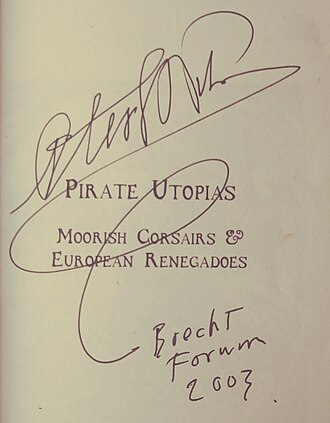
哈基姆·贝
- 生卒
- 1945 – 2022
- 国籍
- 美国
- 外文名
- Peter Lamborn Wilson
照片:Jay Dobkin,CC BY-SA 4.0,来自维基共享资源「Pirate Utopias, autographed.jpg」(经缩小)。
生平与创作
这个词条暂时没有中文维基百科条目,下面是英文维基百科的内容(英文原文):
Peter Lamborn Wilson (October 20, 1945 – May 22, 2022) was an American anarchist author, philosopher, poet, translator, and essayist. He is primarily known for his concept of Temporary Autonomous Zones, short-lived spaces that elude formal structures of control. During the 1970s, Wilson lived in the Middle East and worked at the Imperial Iranian Academy of Philosophy under the guidance of Iranian philosopher Seyyed Hossein Nasr, where he explored Sufism, mysticism, and Persian literature. Starting in the 1980s, he wrote numerous political and countercultural texts under the pen name Hakim Bey, developing ideas such as "ontological anarchy", "poetic terrorism", and "immediatism". His work circulated through small presses, zine networks, anarchist milieus, radio, rave culture, and later academic discussions of post-anarchism, cyberculture, and radical protest. His style of anarchism has drawn criticism for its emphasis on individualism and mysticism, as did some of his writings about pederasty, which he later regretted.
Life
Wilson was born in Baltimore on October 20, 1945. While undertaking a classics major at Columbia University, Wilson met Warren Tartaglia, then introducing Islam to students as the leader of a group called the Noble Moors. Attracted by the philosophy, Wilson was initiated into the group, but later joined a group of breakaway members who founded the Moorish Orthodox Church. The Church maintained a presence at the League for Spiritual Discovery, the group established by Timothy Leary.
Appalled by the social and political climate, Wilson decided to leave the United States, and shortly after the assassination of Martin Luther King Jr., in 1968 he flew to Lebanon, later reaching India with the intention of studying Sufism, but became fascinated by Tantra, tracking down Ganesh Baba. He spent a month in a Kathmandu missionary hospital being treated for hepatitis, and practised meditation techniques in a cave above the east bank of the Ganges. He also allegedly ingested significant quantities of cannabis.
Wilson travelled on to Pakistan. There he lived in several places, mixing with princes, Sufis, and gutter dwellers, and moving from teahouses to opium dens. In Quetta he found "a total disregard of all government", with people reliant on family, clans or tribes, which appealed to him.
Wilson then moved to Iran, where he developed his scholarship. He translated classical Persian texts with French scholar Henry Corbin, and also worked as a journalist at the Tehran Journal. During his years in Iran, Wilson was also connected to the Shiraz Arts Festival, visiting the festival and writing on some of its projects. In 1974, Farah Pahlavi, Empress of Iran, commissioned her personal secretary, scholar Seyyed Hossein Nasr, to establish the Imperial Iranian Academy of Philosophy. Nasr offered Wilson the position of director of its English-language publications, and editorship of its journal Sophia Perennis, which Wilson edited from 1975 until 1978. He would go on to also publish on the Ni'matullāhī Sufi Order and Isma'ilism with Nasrollah Pourjavady.
Following the Iranian Revolution in 1979, Wilson lived in New York City, sharing a brownstone townhouse with William Burroughs, with whom he bonded over their shared interests. Burroughs acknowledged Wilson for providing material on Hassan-i Sabbah which he used for his novel The Western Lands.
In the 1980s, Wilson became associated with New York's underground publishing and radio scenes. He hosted the late-night WBAI program Moorish Orthodox Radio Crusade, a freeform radio show connected to the Moorish Orthodox milieu, on which he read from zines, took calls, and played music gathered during his travels.
In later life, Wilson lived in upstate New York in conditions he termed "independently poor". He has been described as "a subcultural monument".
Towards the end of his life, he showed an interest in the Bābī religion, especially in its Azali form. This was mentioned in his two final books published in early 2022.
Wilson died of heart failure on May 22, 2022, in Saugerties, New York.
Pen name
Wilson's occasional pen name of Hakim Bey was derived from il-Hakim, the alchemist-king, with "Bey" a further nod to Moorish Science. Wilson's two personas, as himself and Bey, were facilitated by his publishers, who provided separate author biographies even when both appeared in the same publication.
Ideas and writings
Ontological anarchy
In Immediatism (1994), a compilation of essays, Wilson explained his particular conception of anarchism and anarchy, which he called ontological anarchy. He posits that since absolute certainty about the "true nature of things" is impossible, all human endeavors are fundamentally "founded on nothing". This perspective embraces chaos not as an absence, but as the essence of life and becoming, contrasting it with order, which is seen as death or cessation.
Unlike traditional anarchism, which might seek a new form of order, ontological anarchy asserts that no "state" can truly exist within chaos, rendering all governance impossible. The goal is not a "Revolutionary" institution, but a continuous evasion of power and a pursuit of the excessive and strange. In the same compilation, Wilson discussed his view of individuals' relations to the outside world as perceived by the senses, and a theory of liberation that he called "immediatism."
Temporary Autonomous Zones
Wilson wrote articles on types of what he called temporary autonomous zones (TAZ), of which he said in an interview:
... "the real genesis was my connection to the communal movement in America, my experiences in the 1960s in places like Timothy Leary's commune in Millbrook ... Usually only the religious ones last longer than a generation—and usually at the expense of becoming quite authoritarian, and probably dismal and boring as well. I've noticed that the exciting ones tend to disappear, and as I began to further study this phenomenon, I found that they tend to disappear in a year or a year and a half.
以上文字摘自英文维基百科「Peter Lamborn Wilson」(有删节,去掉了参考文献等尾部小节),按 CC BY-SA 4.0 使用,作者为维基百科的各位编者。
资料卡
- 母语名
- Peter Lamborn Wilson
- 笔名
- Hakim Bey
- 出生
- 1945 年 10 月 20 日
- 出生地
- 巴尔的摩
- 逝世
- 2022 年 5 月 22 日
- 逝世地
- 索格蒂斯
- 职业
- 诗人、历史学家、译者、作家、哲学家、理论家、文化研究学者、散文家
- 使用语言
- 英语
- 受谁影响
- 夏尔·傅立叶、弗里德里希·尼采、加布里埃尔·邓南遮、罗伯特·安东·威尔森、蒂莫西·利里
- 代表作
- 永久自治区、Pirate Utopias
资料卡来自 Wikidata Q551377(CC0),众包数据,个别字段可能不全。
本站收录的作品(1)
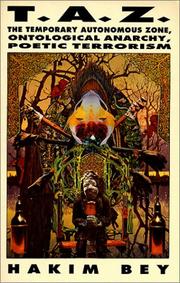
作品年表(1 本)
本站书库里署名哈基姆·贝的书(Open Library 上至少 10 人加过书架的才收),按首版年份排(有本站书页的用 Wikidata 记的首版年,其余用 Open Library 的);年份偶尔记成后来的版本或译本,以原书为准。全部作品见 Open Library。
- 1991永久自治区T.A.Z.书架 14