 书单
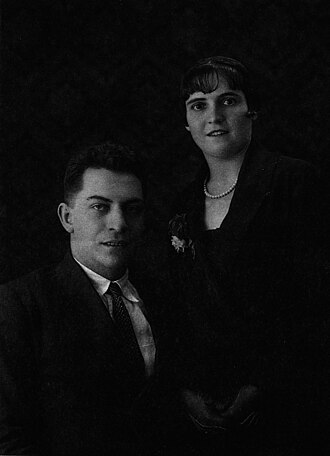
Manuel Chaves Nogales
- 生卒
- 1897 – 1944
- 国籍
- 西班牙
照片:作者不详,公有领域,来自维基共享资源「Chaves nogales 002.jpg」(经缩小)。
生平与创作
这个词条暂时没有中文维基百科条目,下面是英文维基百科的内容(英文原文):
Manuel Chaves Nogales (7th August 1897 – 8th May, 1944) was a Spanish journalist and writer. Politically he was a moderate left-wing republican democrat who defined himself as "antifascist and antirevolutionary". As such, he was an enthusiastic supporter of the Second Spanish Republic.
Biography
Chaves's father was himself a journalist, and he began working in the newspaper El Liberal in Seville whilst he was still very young. In 1922 he moved with his wife and daughter to Madrid and there he worked for the Heraldo de Madrid with other young promising journalists.
In 1927 he won the most prestigious journalist prize in Spain, the Mariano de Cavia, with a feature article on Ruth Elder, the first woman to fly solo across the Atlantic. Because he was enthusiastic about the future he embarked on many risky flights including an adventurous flight to the new USSR, which gave him material for three new books: Around the World in an Aircraft; A Bourgeois in Red Russia and A Bolshevik in Love.
In 1931 he was appointed editor in chief of the influential newspaper, Ahora, ideologically supportive of the Republic and Manuel Azaña.
The following years he travelled extensively throughout Europe and the result was two more books on the Russian revolution: What is Left of the Empire of Tzars, published in 1931, and Juan Martinez, Who was There, published in 1934 which tells the story of a Spanish dancer who was caught in Russia during the 1917 revolution.
In 1935 he published a book on bullfighting, Juan Belmonte, matador de toros, su vida y sus hazañas, which was translated into English (as Juan Belmonte, Killer of Bulls). It was also translated into French.
When the Spanish Civil War broke out in July 1936 Chaves supported the cause of the Republic and stayed in Madrid, even though Ahora was seized by a revolutionary committee; but when the republican government abandoned Madrid and fled to Valencia he, like many other Spanish intellectuals, felt forced to leave Spain, horrified by the political repression practised by the advancing national army that were preparing Madrid besiege.
In exile in Paris in 1936 he worked for Cooperation Paris Service which sent articles to various South American newspapers. In Paris he also collaborated with the L’Europe Nouvelle and Candide.
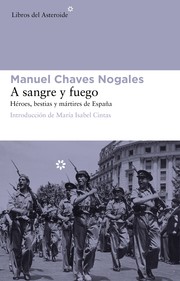
In 1937 he published a new book, A sangre y fuego. Héroes, Bestias y Mártires de España (By Fire and Sword. Heroes, Beasts and Martyrs of Spain), considered one of the best books on the suffering of both sides of the civil war. In the prologue, Manuel Chaves writes that, "brutality and stupidity reigned in Spain, fed equally by the fever of communism and the blandness of fascism".
Owing to his many articles denouncing the advance of German fascism, his name was included on the Gestapo list and he was once again forced to abandon Paris when the German army approached the French capital, expressing his most profound disappointment and even outrage at the behaviour of French politicians on both the right and the left, and most of the Parisian populace.
In 1940 he arrived in London and between 1941 and 1942 he directed The Atlantic Pacific Press Agency, worked at the Evening Standard where he had his own column, and collaborated with BBC Overseas Broadcasts.
His wife and four children had returned to the south of Spain in 1940, fleeing from the German invasion of France and so Manuel Chaves Nogales lived on his own in London for four years whilst he continued his work as a journalist, fighting against extreme right and extreme left positions. He died in May 1944 of peritonitis at the age of 46. He is buried in an unmarked grave at North Sheen Cemetery in Kew, London.
Works
Narraciones Maravillosas y biografías ejemplares de algunos grandes hombres humildes y desconocidos: Caro Raggio, Madrid 1920. Libros Clan A. Gráficas S.L. 1994.
La ciudad, Talleres de La Voz, Sevilla 1921. Universidad de Sevilla, colección de bolsillo 1977. New edition 2005.
La vuelta a Europa en avión. Un pequeño burgués en la Rusia roja: Mundo Latino C.I.A.P., Madrid 1929.
La bolchevique enamorada (El amor en la Rusia roja): Esther Barcelona 1929.
El maestro Juan Martínez que estaba allí: Estampa 1934. Second edition, Colección Castillejo Narrativa, Sevilla 1992. Libros del Asteroide, Barcelona 2006.
Juan Belmonte, matador de toros; su vida y sus hazañas: Estampa, Madrid 1935. Reissued: Alianza Editorial, Madrid 1992. English edition edited and translated by Leslie Charteris: Juan Belmonte, killer of bulls, W.W. Norton company inc. New York 1939.
A sangre y fuego. Héroes, Bestias y Mártires de España: Ercilla, Santiago de Chile 1937. Espasa Editorial, Madrid. 2001. English translation: Heroes and Beasts of Spain, New York 1939.
La agonía de Francia (The Fall on France): Editores Claudio García & Cía., Montevideo 1941. Biblioteca de Autores Sevillanos, Diputación de Sevilla 2001.
Ifni, Spaniens letztes koloniale Abenteuer / aus dem Spanischen und eingeführt von Frank Henseleit, Köln : Kupido Literaturverlag, 2021, ISBN 978-3-96675-035-6
以上文字摘自英文维基百科「Manuel Chaves Nogales」(去掉了参考文献等尾部小节),按 CC BY-SA 4.0 使用,作者为维基百科的各位编者。
资料卡
- 出生
- 1897 年 8 月 7 日
- 出生地
- 塞维利亚
- 逝世
- 1944 年 5 月 4 日
- 逝世地
- 伦敦
- 职业
- 新闻工作者、作家
- 使用语言
- 西班牙语
- 创作体裁
- 传记、随笔
- 领域
- 新闻学
- 配偶
- Ana Pérez Ruiz
- 代表作
- A sangre y fuego
资料卡来自 Wikidata Q3031671(CC0),众包数据,个别字段可能不全。
本站收录的作品(1)
作品年表(1 本)
本站书库里署名Manuel Chaves Nogales的书(Open Library 上至少 10 人加过书架的才收),按首版年份排(有本站书页的用 Wikidata 记的首版年,其余用 Open Library 的);年份偶尔记成后来的版本或译本,以原书为准。全部作品见 Open Library。
- 1937A sangre y fuego书架 12