 书单
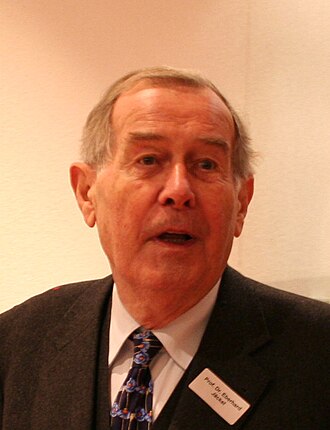
埃伯哈德·耶克尔
- 生卒
- 1929 – 2017
- 国籍
- 德国
- 外文名
- Eberhard Jäckel
照片:Dirk Baranek from Stuttgart, Germany,CC BY 2.0,来自维基共享资源「Eberhard Jäckel.jpg」(经缩小)。
生平与创作
这个词条暂时没有中文维基百科条目,下面是英文维基百科的内容(英文原文):
Eberhard Jäckel ([ˈeːbɐhaʁt ˈjɛkəl]; 29 June 1929 – 15 August 2017) was a German historian. In the 1980s, he was a principal protagonist in the Historians' Dispute (Historikerstreit) over how to incorporate Nazi Germany and the Holocaust into German historiography and over Hitler's intentions.
Career
Born in Wesermünde, Hanover, Jäckel studied history at Göttingen, Tübingen, Freiburg, Gainesville, and Paris after World War II. After serving as an assistant and docent at Kiel until 1966, he taught from 1967 and followed Golo Mann as Professor for Modern History at the University of Stuttgart, a position that Jäckel retained until retirement in 1997.
Jäckel's PhD dissertation was turned into his first book around 1966's Frankreich in Hitlers Europa ("France In Hitler's Europe"), a study of German policy towards France from 1933 to 1945. Jäckel first rose to fame through his 1969 book Hitlers Weltanschauung ("Hitler's Worldview"), which was an examination of Hitler's worldview and beliefs. Jäckel argued that far from being an opportunist with no beliefs, as had been argued by Alan Bullock, Hitler held to a rigid set of fixed beliefs and consistently acted from his "race and space" philosophy throughout his career. In Jäckel's opinion, the core of Hitler's worldview was his belief in what he saw as the merciless struggle for survival between the "Aryan race" and the "Jewish race" and in his belief that stronger "races" possessed large amounts of Lebensraum (living space). In Jäckel's view, everything that Hitler did throughout his life stemmed from the beliefs he had adopted in the 1920s.
Jäckel argued that Hitler felt there were three factors that determined a people's "racial value": its awareness of itself, the type of leadership that it had and its ability to make war. According to Jäckel, those for Germany meant ultranationalism, the Führerprinzip (Führer Principle) and militarism, and all three were the constants of Hitler's beliefs throughout his life. In Jäckel's opinion, Mein Kampf is a long rant against the three principles that Hitler saw as the antithesis of his three sacred principles: internationalism, democracy and pacifism. Jäckel asserted that for Hitler "the originators and bearers of all three counterpositions [were] the Jews". In Jäckel's view, Hitler in the Zweites Buch of 1928 established for the first time a logical link between his foreign policy conception and his antisemitism. They were synthesized in his view of history. With this, Hitler's Weltanschauung had finally achieved the kind of consistency for which he had groped for a long time.
In that way, Jäckel argued that Mein Kampf was a "blueprint" not only for power but also for genocide. Jäckel considered
He [Hitler] had to annihilate the Jews, thus restoring the meaning of history, and with the thus restored, nature-intended struggle for existence, he at the same time had to conquer new living space for the German people. Each of these tasks was inextricably linked to the other. Unless the Jews were annihilated there would very soon no longer be any struggle for living space, nor therefore any culture and consequently nations would die out; not just the German nation, but ultimately all nations. But if, on the other hand, the German people failed to conquer new living space, it would die out because of that and the Jews would triumph.
Jäckel took the view that Hitler's ideology developed in stages in the 1920s. Jäckel wrote: "It is an important fact that the final completion [of Hitler's ideology], contrary to Hitler's own statements, in 1919 had only begun". In addition, Jäckel's book can be seen noteworthy as the first account of Hitler's beliefs written in Germany by someone from the left. (Jäckel joined the SPD in 1967.)
In regard to the foreign policy debates, Jäckel was a leading "continentalist" and argued that Nazi foreign policy aimed only at the conquest of Eastern Europe, as opposed to the "globalists", who argued that Hitler wanted world conquest.
Genesis of the Final Solution
Jäckel was one of the leading intentionalists in regard to the functionalism versus intentionalism debates. Since the 1960s, he argued on that there was a long-range plan on the part of Hitler to exterminate the Jewish people from about 1924. Those views led to intense debates with functionalist historians such as Hans Mommsen and Martin Broszat. Jäckel dismissed the argument made by Broszat in his 1977 essay "Hitler and the Genesis of the Final Solution" that local officials began the Holocaust on their own initiative under the grounds that there was a great deal of evidence that some [local officials] were shocked or even appalled when the Final Solution came into effect. To be sure, they did not disagree with it. But they agreed only reluctantly, referring again to an order given by Hitler. This is a strong indication that the idea did not originate with them.
以上文字摘自英文维基百科「Eberhard Jäckel」(有删节,去掉了参考文献等尾部小节),按 CC BY-SA 4.0 使用,作者为维基百科的各位编者。
资料卡
- 母语名
- Eberhard Jäckel
- 出生
- 1929 年 6 月 29 日
- 出生地
- Wesermünde
- 逝世
- 2017 年 8 月 15 日
- 逝世地
- 斯图加特
- 职业
- 现代史学家、历史学家、大学教师
- 使用语言
- 德语
- 就读学校
- 蒂宾根大学、巴黎大学、佛罗里达大学、哥廷根大学、弗赖堡大学
- 领域
- 德国历史、历史
- 所属团体
- 德国笔会、海德堡科学与人文学院(1995)、波兰科学院
- 代表作
- Hitlers Weltanschauung
- 获奖
- 巴登-符腾堡州功绩勋章(1999);另有 2 项只有外文名
资料卡来自 Wikidata Q71397(CC0),众包数据,个别字段可能不全。
本站收录的作品(1)
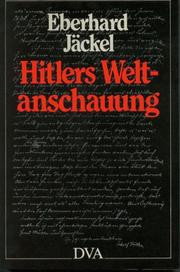
作品年表(1 本)
本站书库里署名埃伯哈德·耶克尔的书(Open Library 上至少 10 人加过书架的才收),按首版年份排(有本站书页的用 Wikidata 记的首版年,其余用 Open Library 的);年份偶尔记成后来的版本或译本,以原书为准。全部作品见 Open Library。
- 1969Hitlers Weltanschauung书架 10