 书单

克里斯多夫·雅歌塔
- 生卒
- 1935 – 2011
- 国籍
- 匈牙利、瑞士
- 外文名
- Ágota Kristóf
照片:Pan Peter12,CC BY-SA 3.0,来自维基共享资源「Agata Kristof, Szhely Kanizsai Gimnázium Tabló (1954).jpg」(经缩小)。
生平与创作
克里斯多夫·雅歌塔(匈牙利语:Kristóf Ágota,1935年10月30日—2011年7月27日),匈牙利裔女作家,1956年因匈牙利反共革命随前夫避难至瑞士,于纳沙泰尔市定居,使用法语写作。
生平
雅歌塔在十四岁时开始以匈牙利语写诗,定居瑞士初期依然使用匈牙利语写诗,并发表于法国印行的匈牙利文学评论上。在瑞士,她从钟表工厂的工人做起,后来尝试以法语写作。雅歌塔的处女作为《恶童日记》,在法国甫出版即受注目,与续集《二人证据》及《第三谎言》,结合为《恶童三部曲》。1992年,雅歌塔以《第三谎言》获得法国图书文学奖(Livre Inter),其作品已被译为三十五种语言以上。雅歌塔本人曾说,《恶童三部曲》内容取材自1944年她在匈牙利塞格德市的真实经历,双胞胎的原型就是她和她的哥哥。
2011年7月26日晚间,雅歌塔在瑞士纳沙泰尔家中去世,享年75岁。
主要作品
《恶童日记》(Le Grand Cahier,1986)
《二人证据》(La Preuve,1988)
《第三谎言》(Le Troisième Mensonge,1991)
《昨日》(Hier,1995)
《文盲》(L'Analphabète,2004)
《恶梦》(C'est égal,2005)
剧作集
《怪物》(Le monstre : et autres pièces,1994)
《传染病》(Un rat qui passe,1995)
荣誉
意大利莫拉维亚奖(1988年)
法国图书文学奖(Prix du Livre Inter,1992年)
瑞士克勒奖(Gottfried-Keller-Preis,2001年)
瑞士席勒文学奖(Schweizerische Schillerstiftung,2005年)
奥地利国家欧洲文学奖(2008年)
匈牙利科苏特奖(2011年)
以上文字摘自维基百科「克里斯多夫·雅歌塔」(去掉了参考文献等尾部小节),按 CC BY-SA 4.0 使用,作者为维基百科的各位编者。
中文维基百科的条目比较短,下面附上英文维基百科的内容(英文原文):
Ágota Kristóf (Hungarian: Kristóf Ágota; 30 October 1935 – 27 July 2011) was a Hungarian writer who lived in Switzerland and wrote in French. Kristóf received the "European prize" (Prix Europe, a.k.a. Prix Littéraire Europe, Grand Prix Littéraire Européen) from ADELF, the association of Francophone authors, for Le Grand Cahier (1986; later translated into English as The Notebook). It was followed by two sequels which are collectively The Notebook Trilogy. She won the 2001 Gottfried Keller Award in Switzerland and the Austrian State Prize for European Literature in 2008.
Early life
Ágota Kristóf was born in Csikvánd, Hungary on 30 October 1935. Her parents were Kálmán Kristóf, an elementary school teacher and Antónia Turchányi, a professor of arts. At the age of 21, she had to leave her country when the Hungarian Revolution of 1956 was suppressed by the Soviet military. She, her husband (who used to be her history teacher at school) and their 4-month-old daughter escaped to Neuchâtel in Switzerland. After five years of loneliness and exile, she quit her work in a factory and left her husband. She started studying French and began to write novels in that language.
Career
Kristóf's first steps as a writer were in the realm of poetry and theater (John et Joe, Un rat qui passe), aspects of her writing that did not have as great an impact as her prose. In 1986 Kristóf's first novel, The Notebook, appeared. It was the beginning of The Notebook Trilogy. The sequel titled The Proof came two years later. The third part was published in 1991 under the title The Third Lie. The most important themes of this trilogy are war and destruction, love and loneliness, promiscuousness, desperation, and attention-seeking sexual encounters, desire and loss, and the dichotomies truth and fiction.
The Notebook was translated into more than 40 languages. In 1995 she published a new novel, Yesterday. Kristóf also wrote a book called L'analphabète (in English The Illiterate), published in 2004. This is an autobiographical text. It explores her love of reading as a young child, and we travel with her to boarding school, over the border to Austria and then to Switzerland. Forced to leave her country due to the failure of the anti-communist rebellion, she hopes for a better life in Zürich.
In 2006, two pieces were published together by Editions Zoé, "Où es-tu Mathias?" followed by "Line, le temps". The names Mathias and Line are from her previous novels. The majority of her works were published by Editions du Seuil in Paris. She died on 27 July 2011 in her Neuchâtel home. Her estate is archived in the Swiss Literary Archives in Bern.
Awards and honors
1986: Prix européen de l’ADELF
1988: Ruban de la Francophonie
1992: Prix du Livre Inter
1998: Prix Alberto Moravia
2001: Gottfried-Keller-Preis
2005: Schiller Prize for her entire body of work
2006: Preis der SWR-Bestenliste
2008: Austrian State Prize for European Literature
2009: Prix de l'institut neuchâtelois
2011: Kossuth Prize
In popular culture
The video game Mother 3 (2006) was influenced by The Notebook's major themes. Main characters Lucas and Claus are named after the book's narrators. The game's designer, Shigesato Itoi, a published author in his own right, compared the novel favorably to an RPG. American novelist Stephen Beachy has named Kristóf as an influence on his novel boneyard.
Burning in the Wind (2002) is a film based on the novel Hier (Yesterday), directed by Silvio Soldini. Le Continent K. (1998) and Agota Kristof, 9 ans plus tard ... (2006) are two short documentaries about Ágota Kristóf directed by Eric Bergkraut. The Notebook was adapted into a film in 2013 by director János Szász. In 2014, the novel was adapted for the stage by British contemporary theatre company, Forced Entertainment.
以上文字摘自英文维基百科「Ágota Kristóf」(去掉了参考文献等尾部小节),按 CC BY-SA 4.0 使用,作者为维基百科的各位编者。
资料卡
- 出生
- 1935 年 10 月 30 日
- 出生地
- 奇克万德
- 逝世
- 2011 年 7 月 27 日
- 逝世地
- 纳沙泰尔
- 职业
- 作家、剧作家、诗人、小说家
- 使用语言
- 法语、匈牙利语
- 写作语言
- 法语、匈牙利语
- 领域
- 散文、诗歌
- 代表作
- 恶童日记、L’analphabète : récit autobiographique
- 获奖
- 科苏特奖(2011)、图书文学奖(1992)、奥地利国家欧洲文学奖(2008)、克勒奖(2001);另有 3 项只有外文名
资料卡来自 Wikidata Q123216(CC0),众包数据,个别字段可能不全。
本站收录的作品(1)
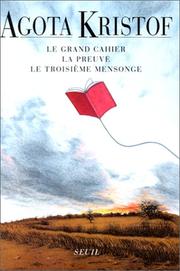
作品年表(3 本)
本站书库里署名克里斯多夫·雅歌塔的书(Open Library 上至少 10 人加过书架的才收),按首版年份排(有本站书页的用 Wikidata 记的首版年,其余用 Open Library 的);年份偶尔记成后来的版本或译本,以原书为准。全部作品见 Open Library。
- 1986恶童日记Le grand cahier书架 35
- 1995Le Grand Cahier - La Preuve - Le Troisième Mensonge书架 10
- 2014Trilogia della città di K.书架 13