 书单
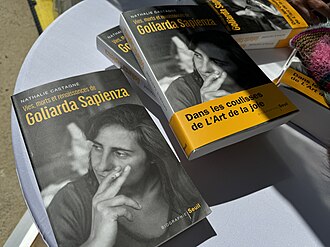
Goliarda Sapienza
- 生卒
- 1924 – 1996
- 国籍
- 意大利、意大利王国
照片:ActuaLitté,CC BY-SA 2.0,来自维基共享资源「Goliarda Sapienza (Seuil).jpg」(经缩小)。
生平与创作
这个词条暂时没有中文维基百科条目,下面是英文维基百科的内容(英文原文):
Goliarda Sapienza (Italian pronunciation: [ɡoˈljarda saˈpjɛntsa]; 10 May 1924 – 30 August 1996) was an Italian actress and writer. She is best known for her 1998 novel The Art of Joy.
Life
Early life
Sapienza was born on 10 May 1924 in Catania, Sicily, to Maria Giudice (1880–1953) and Giuseppe "Peppino" Sapienza (1880–1949). Giudice, a prominent journalist originally from Lombardy, was a feminist activist as well as a prominent member of the Italian Socialist Party who had been repeatedly imprisoned for her beliefs. Giudice collaborated with national and international left-wing intellectuals, including Angelica Balabanoff, Antonio Gramsci, Lenin, and Umberto Terracini. Giudice had a "free union" relationship with Carlo Civardi, who had died while fighting as a soldier in World War I, leaving her with seven children to raise. In 1919 Giudice moved to Sicily to help organize the local socialist organizations and trade unions. It was in Catania that she met Peppino Sapienza, who had raised himself from the working class to become a lawyer. He was later to help draft the Constitution of Italy.
Giudice and Sapienza started a family together (though they never married). Goliarda Sapienza was their second child, and was named for her brother, Goliardo, who died before she was born. She had many step-siblings from her parents’ previous families who lived together in the same house in Via Pistone, Catania. Giudice was at one time the manager of the Italian Marxist philosopher Antonio Gramsci at the newspaper Grido del Popolo; Gramsci had acted as a babysitter to Sapienza's older siblings.
Sapienza spent her childhood in a non-conformist feminist anti-fascist and anti-clerical environment, where she was exposed to a mix of different class backgrounds and to active political involvement. Since her father did not want her to be indoctrinated by the fascist propaganda of the Mussolini regime she was removed from the formal school system when she was 14 and home-schooled. Sapienza taught herself drama and piano, and re-enacted films she had seen in the cinema.
In 1941, at the age of 16, she won a scholarship to study theatre from the Accademia Nazionale di Arte Drammatica in Rome, where she moved with her mother. Following the armistice in 1943 she joined the partisans with her father, who was involved in the raid that freed Sandro Pertini and Giuseppe Saragat from a German prison.
Post war
After the end of the Second World War, Sapienza embarked on a career as a theatrical actress, distinguishing herself in the roles of Pirandello protagonists. She also acted occasionally in the film industry, encouraged by Alessandro Blasetti.
Due to her larger-than-life personality and acting talent, she became a central figure in the neorealist cinema and Communist Party circles of Roman intellectual life. In 1947, she met the neorealist director Francesco Maselli, with whom she entered into a relationship that would last nearly 20 years. The couple mixed with, among others, the authors Alberto Moravia and Elsa Morante, the directors Bernardo Bertolucci and Pier Paolo Pasolini, and the screenwriter Cesare Zavattini. Through these relationships and as Maselli's partner and a confidante to Luchino Visconti, both of whom were influential directors, she assisted in shaping the Italian film industry of the 1950s, serving as an occasional actress and assistant working on casting, screenwriting and voice-overs, for which she often received no credit.
Commences writing
Sapienza started writing around the time of her mother's death in 1953, first producing poetry. In the late 1950s, she suffered serious bouts of depression, which led in 1962 to a suicide attempt by overdosing on sleeping pills. To combat her affliction she underwent a series of electroshocks that caused her to partially lose her memory. She had psychoanalytical therapy at a clinic in Rome and fell in love with her analyst, who responded by terminating the treatment. She was assisted in her recovery by writing, which she had increasingly focused on from 1958.
In 1964 she made a second suicide attempt.
In 1965 Sapienza and Maselli separated, which led to her being shunned by many in Roman society. Freed from the social duties that came with being Maselli's companion, she wrote two memoirs in quick succession, both published to minor acclaim: Lettera Aperta (1967), about her childhood, and Il Filo di Mezzogiorno (1969), about her experience in psychoanalysis. These have been described as attempts to reconstruct the memories destroyed by electroshock therapy. She then dedicated herself entirely to writing, which her friend Elsa Morante resented because Sapienza preferred to write rather than come over for lunch.
Sapienza then threw herself into the task of writing what is now considered her masterpiece, L'arte della gioia (The Art of Joy), which took her nine years to complete and drove her to destitution as she withdrew further from society. Finished in 1976, the monumental historical novel was rejected by publishers because of its length (over 700 pages) and its portrayal of a woman unrestrained by conventional morality and traditional feminine roles. It detailed a woman's pursuit of cultural, financial and sexual independence in early 20th-century Sicily, during which she sleeps with both men and women, commits incest and murders a nun. She was unable to find a publisher for it during her lifetime. One rejected it as "a pile of iniquity".
In 1979 she married the writer and actor Angelo Pellegrino (born 1946), who was 22 years her junior, an act that was regarded as scandalous.
以上文字摘自英文维基百科「Goliarda Sapienza」(有删节,去掉了参考文献等尾部小节),按 CC BY-SA 4.0 使用,作者为维基百科的各位编者。
资料卡
- 母语名
- Goliarda Sapienza
- 出生
- 1924 年 5 月 10 日
- 出生地
- 卡塔尼亚
- 逝世
- 1996 年 8 月 30 日
- 逝世地
- 加埃塔
- 职业
- 作家、演员、诗人
- 使用语言
- 意大利语
- 配偶
- 法兰切斯柯·马赛里
资料卡来自 Wikidata Q1587727(CC0),众包数据,个别字段可能不全。
本站收录的作品(1)
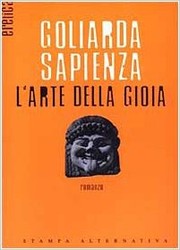
作品年表(1 本)
本站书库里署名Goliarda Sapienza的书(Open Library 上至少 10 人加过书架的才收),按首版年份排(有本站书页的用 Wikidata 记的首版年,其余用 Open Library 的);年份偶尔记成后来的版本或译本,以原书为准。全部作品见 Open Library。
- 1998L'arte della gioia书架 20