书单
尤金 · 萨克尔
- 生卒
- 20 世纪 –
- 国籍
- 美国
- 外文名
- Eugene Thacker
生平与创作
这个词条暂时没有中文维基百科条目,下面是英文维基百科的内容(英文原文):
Eugene Thacker is an American author. He is a professor of media studies at Parsons School of Design in New York City. His writing is associated with the philosophies of nihilism and pessimism. He is known for his books In the Dust of This Planet and Infinite Resignation.
Life and education
Thacker was born and grew up in the Pacific Northwest. He received a Bachelor of Arts degree from University of Washington, and a Master of Arts and Doctor of Philosophy in comparative literature from Rutgers University. Prior to teaching at The New School, he was a professor at Georgia Institute of Technology in the school of literature, media, and communication.
Works
Nihilism, pessimism, and speculative realism
Thacker's work has been associated with philosophical nihilism, pessimism, and to contemporary philosophies of speculative realism and collapsology. His short book Cosmic Pessimism defines pessimism as "the philosophical form of disenchantment": "Pessimism is the night-side of thought, a melodrama of the futility of the brain, a poetry written in the graveyard of philosophy."
Thacker's book Infinite Resignation was published by Repeater Books. The book combines several genres of writing, and consists of fragments, aphorisms, and poetic prose that mixes the personal and philosophical. Thacker engages with writers like Thomas Bernhard, E.M. Cioran, Osamu Dazai, Søren Kierkegaard, Clarice Lispector, Giacomo Leopardi, Fernando Pessoa, and Schopenhauer. The New York Times notes: "Thacker has thrown a party for all of these eloquent cranks in Infinite Resignation, and he is an excellent host… This book provides a metric ton of misery and a lot of company."
Thacker's After Life is a book of philosophy published by the University of Chicago Press. In it, Thacker argues that philosophies of life operates by way of a split between "Life" and "the living," resulting in a "metaphysical displacement" in which life is thought via another metaphysical term, such as time, form, or spirit: "Every ontology of life thinks of life in terms of something-other-than-life...that something-other-than-life is most often a metaphysical concept, such as time and temporality, form and causality, or spirit and immanence" Thacker traces this theme in Aristotle, Dionysius the Areopagite, John Scottus Eriugena, negative theology, Immanuel Kant, and Georges Bataille. After Life also includes comparisons with Islamic, Japanese, and Chinese philosophy.
Thacker's follow-up essay "Darklife: Negation, Nothingness, and the Will-to-Life in Schopenhauer" discusses the ontology of life in terms of negation, eliminativism, and "the inverse relationship between logic and life." Thacker argues that Schopenhauer's philosophy posits a "dark life" in opposition to the "ontology of generosity" of German Idealist thinkers such as Hegel and Schelling. Thacker has also written in a similar vein on the role of negation and "nothingness" in the work of mystical philosopher Meister Eckhart. Ultimately Thacker argues for a skepticism regarding "life": "Life is not only a problem of philosophy, but a problem for philosophy.
Horror and philosophy
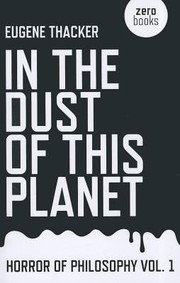
Thacker's most widely read book is In the Dust of This Planet, part of the Horror of Philosophy trilogy. In it, Thacker explores the idea of the "unthinkable world" as represented in the horror genre, in philosophies of pessimism and nihilism, and in "darkness" mysticism. Thacker calls the horror of philosophy "the isolation of those moments in which philosophy reveals its own limitations and constraints, moments in which thinking enigmatically confronts the horizon of its own possibility." Thacker distinguishes the "world-for-us" (a human-centric view of the world), and the "world-in-itself" (the world as it exists), from what he calls the "world-without-us": "the world-without-us lies somewhere in between, in a nebulous zone that is at once impersonal and horrific."
In this and the other volumes of the trilogy Thacker writes about a wide range of work: H.P. Lovecraft, Algernon Blackwood, Edgar Allan Poe, Dante's Inferno, Les Chants de Maldoror by Comte de Lautréamont, the Faust myth, manga artist Junji Ito, contemporary horror authors Thomas Ligotti and Caitlín Kiernan, K-horror film, and the philosophy of Arthur Schopenhauer, Rudolph Otto, Medieval mysticism (Meister Eckhart, Angela of Foligno, John of the Cross), occult philosophy, and the philosophy of the Kyoto School.
These ideas extend to what Thacker calls dark media, or technologies that mediate between the natural and supernatural, and point to the limit of human perception and knowledge. Thacker has written a series of essays on "necrology", the decay or disintegration of the body politic. Thacker writes about plague, demonic possession, and the living dead, drawing upon the history of medicine, biopolitics, political theology, and the horror genre.
Philosophy, science, and technology
Thacker's earlier works adopt approaches from the philosophies of science, technology, and the study of the relation between science and science fiction. Many of his media contributions are developments of Science and Technology Studies. Examples are his book Biomedia, and his writings on bioinformatics, nanotechnology, biocomputing, complex adaptive systems, swarm intelligence, and network theory. Thacker defines biomedia as follows: "Biomedia entail the informatic recontextualization of biological components and processes, for ends that may be medical or nonmedical...biomedia continuously make the dual demand that information materialize itself...biomedia depend upon an understanding of biological as informational but not immaterial."
以上文字摘自英文维基百科「Eugene Thacker」(有删节,去掉了参考文献等尾部小节),按 CC BY-SA 4.0 使用,作者为维基百科的各位编者。
资料卡
- 母语名
- Eugene Thacker
- 出生
- 20 世纪
- 职业
- 哲学家、文学评论家、新闻工作者、艺术家、理论家、作家、作曲家、讲师 等 10 项
- 写作语言
- 英语
- 就读学校
- 罗格斯大学、华盛顿大学
- 文学运动 / 流派
- 虚无主义、悲观主义、思辨实在论、社会崩解、反人文主义
- 领域
- 欧陆哲学、比较文学、媒体研究、宗教哲学
- 受谁影响
- 亚瑟·叔本华、弗里德里希·尼采、埃米尔·齐奥朗、乔治·巴代伊、米歇尔·福柯、伊曼努尔·康德、亚里士多德、勒内·笛卡儿、威廉·弗卢塞尔、H·P·洛夫克拉夫特
- 代表作
- Horror of Philosophy
资料卡来自 Wikidata Q17154156(CC0),众包数据,个别字段可能不全。