书单
百科
这个词条暂时没有中文维基百科条目,下面是英文维基百科的内容(英文原文):
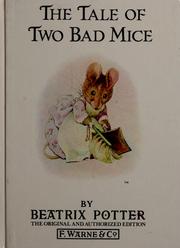
The Tale of Two Bad Mice is a children's book written and illustrated by Beatrix Potter, and published by Frederick Warne & Co. in September 1904. Potter took inspiration for the tale from two mice caught in a cage-trap in her cousin's home and a doll's house being constructed by her editor and publisher Norman Warne as a Christmas gift for his niece Winifred. While the tale was being developed, Potter and Warne fell in love and became engaged, much to the annoyance of Potter's parents, who were grooming their daughter to be a permanent resident and housekeeper in their London home.
The tale is about two mice who vandalise a doll's house. After finding the food on the dining room table made of plaster, they smash the dishes, throw the doll clothing out the window, tear the bolster, and carry off a number of articles to their mouse-hole. When the little girl who owns the doll's house discovers the destruction, she positions a policeman doll outside the front door to ward off any future depredation. The two mice atone for their crime spree by putting a crooked sixpence in the doll's stocking on Christmas Eve and sweeping the house every morning with a dust-pan and broom.
The book was critically well received and brought Potter her first fan letter from America. The tale was adapted to a segment in the 1971 Royal Ballet film The Tales of Beatrix Potter and to an animated episode in the BBC series The World of Peter Rabbit and Friends. Merchandise inspired by the tale includes Beswick Pottery porcelain figurines and Schmid music boxes.
Development and publication
The Tale of Two Bad Mice had its genesis in June 1903 when Potter rescued two mice from a cage-trap in her cousin Caroline Hutton's kitchen at Harescombe Grange, Gloucestershire, and named them Tom Thumb and Hunca Munca after characters in Henry Fielding's play, Tom Thumb. Tom Thumb was never mentioned in Potter's letters after his rescue from the trap (he may have escaped) but Hunca Munca became a pet and a model; she developed an affectionate personality and displayed good housekeeping skills.
Between November 26, 1903 and December 2, 1903, Potter took a week's holiday in Hastings, and, though there is no evidence that she did so, she may have taken one or both mice with her. She composed three tales in a stiff-covered exercise book during a week of relentless rain: Something very very NICE (which, after much revision, eventually became The Pie and the Patty-Pan in 1905), The Tale of Tuppenny (which eventually became Chapter 1 in The Fairy Caravan in 1929), and The Tale of Hunca Munca or The Tale of Two Bad Mice. Potter hoped that one of the three tales would be chosen for publication in 1904 as a companion piece to Benjamin Bunny, which was then a work in progress. "I have tried to make a cat story that would use some of the sketches of a cottage I drew the summer before last," she wrote to her editor Norman Warne on December 2, "There are two others in the copy book ... the dolls would make a funny one, but it is rather soon to have another mouse book?", referring to her recently published The Tailor of Gloucester.
Warne received and considered the three tales. Potter wrote to him that the cat tale would be the easiest to put together from her existing sketches but preferred to develop the mouse tale. She alerted Warne that she was spending a week with a cousin at Melford Hall and would run the three tales past the children in the house. Warne favoured the mouse tale – perhaps because he was constructing a doll's house in his basement workshop for his niece Winifred Warne – but for the moment, he delayed making a decision and turned his attention to the size of the second book for 1904 because Potter was complaining about being "cramped" with small drawings and was tempted to put more in them than they could hold. Warne suggested a 215 mm x 150 mm format similar to L. Leslie Brooke's recently published Johnny Crow's Garden, but, in the end, Potter opted for the mouse tale in a small format, instinctively aware the format would be more appropriate for a mouse tale and indicating it would be difficult to spread the mice over a large page. Before a final decision was made, Warne fashioned a large format dummy book called The Tale of the Doll's House and Hunca Munca with pictures and text snipped from The Tailor to give Potter a general impression of how a large format product would appear, but Potter remained adamant and the small format and the title The Tale of Two Bad Mice were finally chosen.
Just before New Year's 1904, Warne sent Potter a glass-fronted mouse house with a ladder to an upstairs nesting loft built to her specifications so she could easily observe and draw the mice. The doll's house Potter used as a model was one Warne had built in his basement workshop as a Christmas gift for his four-year-old niece Winifred Warne. Potter had seen the house under construction and wanted to sketch it, but the house had been moved just before Christmas to Fruing Warne's home south of London in Surbiton. Norman Warne invited Potter to have lunch in Surbiton and sketch the doll's house, but Mrs. Potter intervened. She had taken alarm at the growing intimacy between her daughter and Warne; as a consequence, she made the family carriage unavailable to her daughter, and refused to chaperone her to the home of those she considered her social inferiors. Potter declined the invitation and berated herself for not standing up to her mother. She became concerned that the whole project could be compromised.
以上文字摘自英文维基百科「The Tale of Two Bad Mice」(有删节,去掉了参考文献等尾部小节),按 CC BY-SA 4.0 使用,作者为维基百科的各位编者。
资料卡
- 原题
- The Tale of Two Bad Mice
- 插图
- 碧雅翠丝·波特
- 原作语言
- 英语
- 首次出版
- 1904 年 9 月
- 体裁
- 儿童文学
- 首版出版社
- 费德里克·沃恩公司
- 前作
- 小兔本杰明
- 续作
- 提姬·温克尔太太的故事
资料卡来自 Wikidata Q5390567(CC0),众包数据,个别字段可能不全。
更多资料与书评
在哪读
同系列 / 前后作品
碧雅翠丝·波特 的其他作品
作者页 ›