书单
百科
这个词条暂时没有中文维基百科条目,下面是英文维基百科的内容(英文原文):
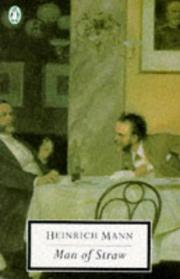
Der Untertan (German: [deːɐ̯ ˈʔʊntɐtaːn]; literally "the underling", translated into English under the titles Man of Straw, The Patrioteer, and The Loyal Subject) is one of the best known novels of German author Heinrich Mann. The title character, Diederich Hessling, a dedicated 'Untertan' in the sense of a person subservient to a monarch or prince, is an immoral man who is meant to serve as an allegory of both the reign of Kaiser Wilhelm II and German society of his time.
The novel was completed during the July Crisis in 1914, shortly before the outbreak of World War I. Extracts had been published in the satirical magazine Simplicissimus from 1912 onwards, causing great controversy. Mann signed a contract with the magazine Die Zeit im Bild for the publication of the censored version of the novel from the beginning of 1914, but on 1 August the publication was stopped as "inappropriate". A book edition was not published until 1918 by Kurt Wolff in Leipzig.
In the novel, Hessling gains a doctorate of chemistry and then starts a business career as a paper manufacturer. He becomes an influential figure in local politics, but his inflexible ideals are contradicted by his own actions. He supports militarism, anti-socialism, and Christian morality, but he refuses to serve in the military, he regularly uses slander against his business rivals, and he acts as the main political supporter of a social democratic politician in order to advance his business schemes.
Plot
The socio-critical novel portrays the life of Diederich Hessling, a slavish and fanatical admirer of Kaiser Wilhelm II, as an archetype of Wilhelmine Germany. The name "Hessling" alludes to the German word for ugly, "hässlich". Hessling is unthinkingly obedient to authority and maintains a rigid dedication to the nationalist goals of the newly created German Empire.
As a self-conscious and snivelling child, he acts as an informer. He later gains self-confidence by joining a duelling student fraternity, practising as a drunkard and Stammtisch agitator, and by narrowly obtaining a doctorate of chemistry. He becomes a paper manufacturer, family patriarch, and eventually the most influential man in his small town.
Throughout the novel, Hessling's inflexible ideals are often contradicted by his actions: he preaches bravery but is a coward; he is the strongest militarist but seeks to be excused from conscription; his greatest political opponents are the Marxist Social Democratic Party of Germany (SPD), yet he uses his influence to help get his hometown's SPD candidate to the Reichstag parliament, in order to defeat his liberal business competitors; he starts vicious rumors against the latter and then dissociates himself from them; he both preaches and enforces Christian morality against others but lies, cheats, and regularly commits adultery.
The plot ends with the solemn inauguration of an Emperor William monument, with Hessling delivering the speech, which is abruptly terminated by an apocalyptic thunderstorm. He also faces the death of Buck, an elderly veteran of the democratic 1848 Revolution.
Reception and criticism
When the novel was fully published in German in 1918, it immediately sold nearly 100,000 copies — the success that Heinrich Mann never achieved again in his entire life, while the author was denounced as a traitor to his country for his "unpatriotic" or even "Communist" stance; at the same time, some reviewers described it as an "account of a gullible people seduced by power". Thomas Mann, Heinrich's more famous young brother who supported Germany in the war, rejected the work as an irresponsible social satire unrelated to the reality, "sheer nonsense", and wrote that "and if it deserved a more noble name, more noble than that of international defamation and national slander, then it would be: ruthless aestheticism". This attitude towards the novel was based not only on his political views and his conflict with his brother: in Reflections of a Nonpolitical Man, a book where Thomas Mann advocated the authoritarianism of the Kaiserreich and defended the war of "German culture" with "the Western civilization", he contrasted his own work based on irony with satire and political art, criticizing the latter two. On the other hand, the novel was welcomed by the Expressionists, whom Thomas Mann also criticized in his book, welcomed the novel as "a long-overdue injection of political blood into the German people". The novel turned Heinrich Mann into a public intellectual whose writings were in the centre of intellectual and political debates off the Weimar Republic, also famous as a person who participated in the November Revolution and worked with the Socialist Kurt Eisner.
After the novel was reissued after the end of World War II, it was dismissed by the critics who claimed satire to be an inferior form of art by definition; some rejected the novel as 'historically inaccurate' by saying that Hessling was "too bad" to be "true"; on the other hand, the novel became a bestseller again, and the supportive critics described it as a great work of world literature, notable for its "prophetic" depiction of "quintessential Wilhelmian German" and his psychological predispositions that founded the authoritarian personality of the 1930s and resulted in the rise of Nazism; Kurt Tucholsky praised it as the "herbarium of the German man". The novel achieved the peak of its popularity in DDR and the Soviet Union, where it was regarded as 'the original anti-fascist novel' and 'the masterpiece of bourgeois-realist literature'. In the West Germany, however, the author was denounced as a Communist sympathizer and the novel was not published until 1964; it was rediscovered primarily under influence of the 1968 student movement. Frederick Betz, a modern critic, regards the novel as "one of the great political novels of the 20th century" for its depiction of the conflict between the authority and democratic principles.
The novel is frequently read in German schools up to today.
以上文字摘自英文维基百科「Der Untertan」(有删节,去掉了参考文献等尾部小节),按 CC BY-SA 4.0 使用,作者为维基百科的各位编者。
资料卡
- 原题
- Der Untertan
- 原作语言
- 德语
- 首次出版
- 1918 年
- 作品形式
- 长篇小说
- 故事发生地
- 柏林
- 故事年代
- 德意志帝国
资料卡来自 Wikidata Q476349(CC0),众包数据,个别字段可能不全。
改编作品
电影1
- 《臣仆》Der Untertan
电视剧 / 剧集1
名单来自 Wikidata(CC0):只列条目里写明「改编自 / 取材于」这本书的作品,不按名字猜;众包数据,可能不全。