书单

启蒙辩证法 (1944)
百科
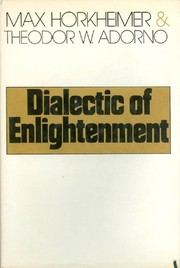
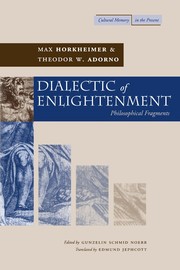
《启蒙辩证法》(德语:Dialektik der Aufklarung: Philosophische Fragmente)是德国哲学家麦克斯·霍克海默与狄奥多·阿多诺于1940年合著的一部片段性哲学论证文章集,是法兰克福学派的重要代表作之一,其基本特征是把对德国法西斯主义的批判追踪到启蒙精神的自我摧毁,并把极权主义归因于科学的逻辑,进而对西方社会和思想进行激进的批判。本书对20世纪哲学,社会学,文化和政治上,特别是20世纪60年代至70年代新左派运动产生了重大的影响。
以上文字摘自维基百科「启蒙辩证法」(去掉了参考文献等尾部小节),按 CC BY-SA 4.0 使用,作者为维基百科的各位编者。
中文维基百科的条目比较短,下面附上英文维基百科的内容(英文原文):
Dialectic of Enlightenment (German: Dialektik der Aufklärung) is a work of philosophy and social criticism written by Frankfurt School philosophers Max Horkheimer and Theodor W. Adorno. The text, published in 1947, is a revised version of what the authors originally had circulated among friends and colleagues in 1944 under the title of Philosophical Fragments (German: Philosophische Fragmente).
One of the core texts of critical theory, Dialectic of Enlightenment explores the socio-psychological status quo that had been responsible for what the Frankfurt School considered the failure of the Enlightenment. They argue that its failure culminated in the rise of fascism, Stalinism, the culture industry and mass consumer capitalism. Rather than liberating humanity as the Enlightenment had promised, they argue it had resulted in the opposite: in totalitarianism, and new forms of barbarism and social domination.
Together with Adorno's The Authoritarian Personality (1950) and fellow Frankfurt School member Herbert Marcuse's One-Dimensional Man (1964), it has had a major effect on 20th-century philosophy, sociology, culture, and politics, especially inspiring the New Left of the 1960s and 1970s.
Historical context
In the 1969 preface to the 2002 publication, Horkheimer and Adorno wrote that the original was written, "when the end of the National Socialist terror was in sight". One of the distinguishing characteristics of the new critical theory, as Adorno and Horkheimer set out to elaborate it in Dialectic of Enlightenment, is a certain ambivalence concerning the ultimate source or foundation of social domination.
Such would give rise to the "pessimism" of the new critical theory over the possibility of human emancipation and freedom. Furthermore, this ambivalence was rooted in the historical circumstances in which Dialectic of Enlightenment was originally produced: the authors saw Nazism, Stalinism, state capitalism, and culture industry as entirely new forms of social domination that could not be adequately explained within the terms of traditional theory.
For Adorno and Horkheimer (relying on economist Friedrich Pollock's thesis on National Socialism), state intervention in the economy and the increasing concentration of capital had concealed the contradiction within capitalism between the coercive relations of production and the level of productive forces—a tension that traditional theory expected to be resolved through a proletarian revolution. The liberal market economy, once associated with individual autonomy and competition among private entrepreneurs, had evolved into a system of centralized planning.
[G]one are the objective laws of the market which ruled in the actions of the entrepreneurs and tended toward catastrophe. Instead the conscious decision of the managing directors executes as results (which are more obligatory than the blindest price-mechanisms) the old law of value and hence the destiny of capitalism.
Because of this, contrary to Marx's famous prediction in his preface to A Contribution to the Critique of Political Economy, this shift did not lead to "an era of social revolution", in Habermas's words, without "anything in reserve to which it might appeal; and when the forces of production enter into a baneful symbiosis with the relations of production that they were supposed to blow wide open, there is no longer any dynamism upon which critique could base its hope". For Adorno and Horkheimer, this posed the problem of how to account for the apparent persistence of domination in the absence of the very contradiction that, according to traditional critical theory, was the source of domination itself.
以上文字摘自英文维基百科「Dialectic of Enlightenment」(有删节,去掉了参考文献等尾部小节),按 CC BY-SA 4.0 使用,作者为维基百科的各位编者。
资料卡
- 原题
- Dialektik der Aufklärung
- 原作语言
- 德语
- 首次出版
- 1944 年
- 体裁
- 非虚构作品、随笔
- 主题
- 哲学、批判理论、法兰克福学派
资料卡来自 Wikidata Q1208415(CC0),众包数据,个别字段可能不全。