书单
百科
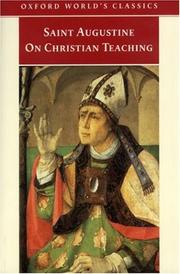
《论基督教教义》(拉丁语:De doctrina christiana),又译为天主圣教启蒙、论基督教信仰,基督教文献,由希波的奥古斯丁写作。其中包括四册著作,用来解释及教导基督教圣经中的教义。其中第一册在397年首次发行,最后的第四册在426年发行。圣奥古斯丁写作这部书的用意,在于教导基督徒,以及提供宣教之用,其目的在于发现存在基督教圣经内容中的真理,教导由圣经而来的真理,以及为圣经的真理而辩护。
以上文字摘自维基百科「論基督教教義」(去掉了参考文献等尾部小节),按 CC BY-SA 4.0 使用,作者为维基百科的各位编者。
中文维基百科的条目比较短,下面附上英文维基百科的内容(英文原文):
De doctrina Christiana (On Christian Doctrine or On Christian Teaching) is a theological text written by Augustine of Hippo. It consists of four books that describe how to interpret and teach the Scriptures. The first three of these books were published in 397 and the fourth added in 426. By writing this text, Augustine set three tasks for Christian teachers and preachers: to discover the truth in the contents of the Scriptures, to teach the truth from the Scriptures, and to defend scriptural truth when it was attacked.
Historical context
Starting in AD 389, the powerful application of faith to politics led Emperor Theodosius to issue a series of edicts against paganism that concluded in 391 with a law making pagan worship illegal. During the Golden Age of Athens, politics and man-made laws guided human conduct, and the city-state was viewed as a manifestation of the highest human values, giving rise to political philosophy. Christianity effected a change in the course of Western society, requiring a new cultural identity and a new educational curriculum. With this aim in mind, Emperor Justinian (AD 483–565) cut off all state funding to chairs of rhetoric, essentially bringing the pagan classical tradition to a close. The classical heritage was from this time onward viewed through the lens of Christianity, increasing the need for an approach to the teaching of scripture that matched the sophistication of the classical inheritance. De doctrina Christiana supplied the medieval world with that tool.
Summary
Prologue
The Prologue consists of a response to those who would resist Augustine's project of providing rules for interpretation of the Scriptures. Augustine outlines three possible objections, including those who do not understand his precepts, those who fail to make effective use of his teachings, and those who believe they are already prepared to interpret the Scriptures. To the first two types of critics, Augustine states that he cannot be held responsible for their inability to understand.
He then addresses the third type of critic, those who believe they are already able to interpret the Scriptures. If their claims are true, he acknowledges that they have received a great blessing. However, they must admit that language itself was learned from a human being, not directly from God. Therefore, God has created human beings to learn from one another, and we ought to learn with humility. All good teaching from human beings derives ultimately from God. The ability to understand obscurity is therefore both the gift of God and reinforced by human teaching.
Book One
Book One discusses enjoyment, use, interpretation, and the relation of various Christian doctrines to these concepts. Augustine begins with a discussion of the steps in the interpretive process: discovery of what is to be understood, and a way of teaching what has been discovered.
He then expands upon the Platonic notion that there are things and signs. Signs are used to symbolize things, but are considered things themselves because they too represent meaning. They are given meaning through their repetition and propagation throughout society.
Some things are to be enjoyed (in Latin, frui), and others are to be used (uti). Things we enjoy are those we find good in themselves, and things we use are those that are good for the sake of something else. The only thing that is to be enjoyed is God. All other things, including other human beings, are to be used in relation to the proper end of enjoyment. To use something which is to be enjoyed or vice versa is to fail to love properly. The discussion of enjoyment and use leads to an extended reflection on motivation, word as flesh, and humanity as image of God.
以上文字摘自英文维基百科「De doctrina Christiana」(有删节,去掉了参考文献等尾部小节),按 CC BY-SA 4.0 使用,作者为维基百科的各位编者。
资料卡
- 原题
- Dē doctrīna christiāna
- 原作语言
- 拉丁语
- 首次出版
- 397 年
资料卡来自 Wikidata Q5244902(CC0),众包数据,个别字段可能不全。