书单
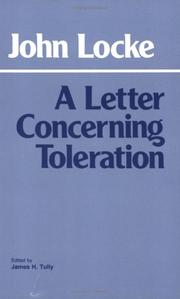
论宗教宽容:致友人的一封信 (1689)
百科
这个词条暂时没有中文维基百科条目,下面是英文维基百科的内容(英文原文):
A Letter Concerning Toleration (Epistola de Tolerantia) by John Locke was written 1685-1686 when Locke was living in exile in the Netherlands, known for its religious tolerance. It is addressed to an anonymous "Honored Sir", later identified as Dutchman Philipp van Limborch. The Letter was originally composed in Latin and was published in English translation in 1689 by William Popple, without Locke's knowledge. The work was written amidst increasing religious turmoil in England. Locke argues for the separation of church and state, with religious toleration as a way to promote religious peace.
Background
In the wake of the discovery of the Rye House Plot and Charles II's persecution of the Whigs, Locke fled England to Amsterdam in the Dutch Republic in September 1683. Throughout his life, Locke was interested in the debate about religious toleration. The question was much debated in Holland during Locke's stay, and in October 1685, Louis XIV of France revoked the Edict of Nantes, which had guaranteed religious toleration for French Protestants, in order to bring to an end to the French Wars of Religion (1562-1598).
In the Dutch Republic, Locke met Philipp van Limborch, a Professor of Divinity. It was to be a discussion with Limborch that persuaded Locke to temporarily put aside his work on An Essay Concerning Human Understanding and set down his ideas on religious toleration. Locke wrote the Letter during the winter of 1685–86.
Argument of the Letter
One of the founders of Empiricism, Locke developed ideas contrary to those by Thomas Hobbes in Leviathan, in supporting toleration for various Christian denominations. Hobbes thought individuals could maintain their own religious beliefs, so long as they outwardly expressed those of the state. It has been argued that Locke's rejection of Catholicism was the ultimate basis for his rejection of the government's interest in spiritual salvation.
Toleration is central to Locke's political philosophy. Consequently, only churches that teach tolerance are allowed in his society. Locke's view on the difficulty of knowing the one true religion may suggest that religion is not personally important to Locke. Still, it also may point to the deep uncertainties surrounding religious belief in a time of political and intellectual conflict. In contrast, Locke's view on atheism suggests that he was far from considering religion unimportant. As an empiricist, he considered practical considerations, such as how the peace of civil society would be affected by religious toleration. Closely reading the text also reveals that Locke relies on Biblical analysis at several key points in his argument.
"That church can have no right to be tolerated by the magistrate," Locke argued, "which is so constituted that all who enter it ipso facto pass into the allegiance and service of another prince". If this were to be tolerated, "the magistrate would make room for a foreign jurisdiction in his territory and...allow for his people to be enlisted as soldiers against his government". This has been interpreted by historians as a reference to the Catholic Church, with the Pope being the prince to whom Catholics owed allegiance.
Catholics
More recently, scholars have challenged the idea that Locke opposed tolerating Catholics in all circumstances. Mark Goldie argues that the traditional interpretation of Locke's position on Catholics "needs finessing, since he did not exclude the theoretical possibility of tolerating Catholics...if Catholics could discard their uncivil beliefs, they could then be tolerated". Goldie asserts that Locke was opposed not to Catholicism as such but antinomianism, the belief that ordinary moral laws are superseded by religious truth. Scott Sowerby claims that Locke left open the possibility that Catholics could be tolerated, if they adopted tolerant principles and rejected political allegiance to the Pope.
John Marshall has argued that several passages in the Letter demonstrate that Locke thought that Catholics "in their terms of worship and religious speculative beliefs...deserved their worship to be free". Marshall also notes that "The combination of Locke's comments in the Letter suggests that during [its] composition ... Locke was once again struggling over how to discriminate between the series of associated political principles which for him made Catholics intolerable, and the religious worship and other religious beliefs of Catholics which deserved toleration." A confirmation of these positions seems to come from a 2019 discovery of a previously unknown manuscript, dated 1667–8, titled Reason for tolerating Papists equally with others, in which Locke makes his earliest arguments for religious toleration.
Non-Christians
Locke's rejection of religious coercion extended beyond England to non-Christian peoples more generally, including the Indigenous populations of the Americas. In the Letter, he argued that pagan subjects under a Christian ruler should not be deprived of life or property on account of their religion and warned against using salvation as a pretext for conquest. He explicitly rejected appeals to the biblical conquest of Canaan as a model for Christian states, insisting that Israel's theocratic history was unique and could not justify violence or dispossession in modern commonwealths.
The Letter is distinctive among Locke's writings on toleration for explicitly addressing Jews as citizens of England rather than merely as illustrative examples. Locke acknowledged the established presence of Jewish communities in late seventeenth-century London and argued that they should not be compelled to conform to Christian worship. He maintained that a Christian magistrate could legitimately govern Jewish subjects without forcing religious conformity. Locke criticized English authorities for restricting Jewish public worship, questioning why Jews were permitted private dwellings but denied synagogues, and arguing that public religious assembly posed no greater danger than private worship.
以上文字摘自英文维基百科「A Letter Concerning Toleration」(有删节,去掉了参考文献等尾部小节),按 CC BY-SA 4.0 使用,作者为维基百科的各位编者。
资料卡
- 原题
- Epistola de Toleratia
- 译者
- William Popple
- 原作语言
- 拉丁语
- 首次出版
- 1689 年
- 体裁
- 随笔
资料卡来自 Wikidata Q914139(CC0),众包数据,个别字段可能不全。