书单
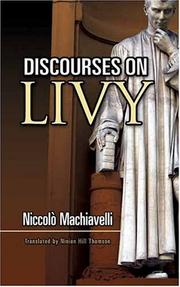
论李维 (1531)
百科
《论李维》(意大利语:Discorsi sopra la prima deca di Tito Livio),原书名意为“论提图斯·李维之《罗马史》前十卷”,是一部关于政治、历史与哲学的作品,由意大利政治哲学家尼科洛·马基雅维利于16世纪创作,是马基雅维利对李维《罗马史》前十卷的心得与诠释。
通称《李维论》或《论李维》,其余又译《李维罗马史前十卷疏论》、《论李维罗马史十章》、《论李维罗马史》、《李维罗马史疏论》、《李维罗马史疏义》、《李维罗马史义解》、《李维史论》等。
本书主要论述了共和制的结构与优点,与马基雅维利的另一部著作《君主论》中论述的君主制相对应,马基雅维利总结了一系列的历史教训,描述了共和国应该如何成立、架构,涵盖了对权力制衡、政治权力分立的好处、以及共和国比君主国优秀之处。《论李维》一书对之后法国的卢梭产生了深远的影响。在《民约论》中,卢梭就多次引用了马基维利的著作。
以上文字摘自维基百科「李維論」(去掉了参考文献等尾部小节),按 CC BY-SA 4.0 使用,作者为维基百科的各位编者。
中文维基百科的条目比较短,下面附上英文维基百科的内容(英文原文):
The Discourses on Livy (Italian: Discorsi sopra la prima deca di Tito Livio, lit. 'Discourses on the First Ten of Titus Livy') is a work of political history and philosophy written in the early 16th century (c. 1517) by the Florentine political theorist Niccolò Machiavelli, best known as the author of The Prince. The Discourses were published posthumously with papal privilege in 1531.
The title identifies the work's subject as the first ten books of Livy's History of Rome, also known as Ab urbe condita, which relate the expansion of Rome through the end of the Third Samnite War in 293 BC, although Machiavelli discusses what can be learned from many other eras including contemporary politics. Machiavelli saw history in general as a way to learn useful lessons from the past for the present, and also as a type of analysis which could be built upon, as long as each generation did not forget the works of the past.
Machiavelli frequently describes Romans and other ancient peoples as superior models for his contemporaries, but he also describes political greatness as something which comes and goes amongst peoples, in cycles.
Outline
Discourses on Livy comprises a dedication letter and three books with a total of 142 numbered chapters. The first two books, but not the third, are introduced by unnumbered prefaces. Much attention has been given to the fact that Livy's History also contained 142 books along with an introduction, as well as to other numerological curiosities present in Machiavelli's writings. At the end of chapter one of Book I, Machiavelli outlines the structure of his work. In Livy's History, Machiavelli observes that Rome's actions are divided into two dichotomies: those taken through public counsel or private counsel, and those occurring either inside or outside the city. The first book focuses on actions taken inside the city by public counsel. The second book, as Machiavelli later notes at the end of the second preface, addresses public counsel regarding matters outside the city. Although this structure would seem to suggest the need for two additional books, there is only one more, which deals with private counsel concerning both internal and external matters.
Dedicatory letter
Machiavelli dedicates the Discourses to two friends, Zanobi Buondelmonti and Cosimo Rucellai, both of whom appear in Machiavelli's Art of War. Rucellai had died in 1519, but this did not lead Machiavelli to find a new dedicatee, as he had with The Prince. Machiavelli justifies dedicating the Discourses to his two friends because they deserve to be princes, even if they lack principalities, and he criticizes the custom (which he had adopted in The Prince) of dedicating works to men who are princes but do not deserve to be.
Book I
Machiavelli notes that Rome's actions as recounted by Livy proceeded either by "public counsel" or by "private counsel", and that they concerned either things inside the city or things outside the city, yielding four possible combinations. He says that he will restrict himself in Book I to those things that occurred inside the city and by public counsel.
In the preface to Book I, Machiavelli explains why he wrote the Discourse, noting that he brings new modes and orders—a dangerous task given the envy of men, but one motivated by the desire to work for the common benefit of humanity. He also notes that while his work may not be perfect, it deserves to be heard, because it will aid others after him in fulfilling his vision. He complains that the Italian Renaissance has stimulated a desire to imitate the ancients in art, law, and medicine, but that no one thinks of imitating ancient kingdoms or republics. He traces this to an improper reading of history that suggests that imitation of ancient political virtue is impossible. He declares his intention to overcome this view of the ancient world by examining Livy and modern politics.
以上文字摘自英文维基百科「Discourses on Livy」(有删节,去掉了参考文献等尾部小节),按 CC BY-SA 4.0 使用,作者为维基百科的各位编者。
资料卡
- 原题
- Discorsi sopra la prima deca di Tito Livio
- 原作语言
- 托斯卡纳语
- 首次出版
- 1531 年
- 体裁
- 专论
资料卡来自 Wikidata Q924424(CC0),众包数据,个别字段可能不全。