书单
百科
这个词条暂时没有中文维基百科条目,下面是英文维基百科的内容(英文原文):
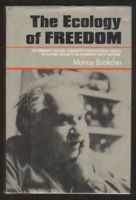
The Ecology of Freedom: The Emergence and Dissolution of Hierarchy is a 1982 book by the American libertarian socialist and ecologist Murray Bookchin, in which the author describes his concept of social ecology, the idea that human social problems cause ecological problems and can be solved only by reorganizing society along ecological and ethical lines. The book is considered Bookchin's magnum opus, but it has also been criticized as utopian.
Summary
Bookchin is critical of the class-centered analysis of Marxism and simplistic anti-state forms of libertarianism and liberalism and wishes to present a more complex view of societies. Bookchin writes that, "My use of the word hierarchy in the subtitle of this work is meant to be provocative. There is a strong theoretical need to contrast hierarchy with the more widespread use of the words class and State; careless use of these terms can produce a dangerous simplification of social reality. To use the words hierarchy, class, and State interchangeably, as many social theorists do, is insidious and obscurantist. This practice, in the name of a "classless" or "libertarian" society, could easily conceal the existence of hierarchical relationships and a hierarchical sensibility, both of which – even in the absence of economic exploitation or political coercion – would serve to perpetuate unfreedom."
Bookchin also points to an accumulation of hierarchical systems throughout history that has occurred up to contemporary societies, which tends to determine the human collective and individual psyche, "The objective history of the social structure becomes internalized as a subjective history of the psychic structure. Heinous as my view may be to modern Freudians, it is not the discipline of work but the discipline of rule that demands the repression of internal nature. This repression then extends outward to external nature as a mere object of rule and later of exploitation. This mentality permeates our individual psyches in a cumulative form up to the present day––not merely as capitalism but as the vast history of hierarchical society from its inception."
Reception
Reviews
The Ecology of Freedom received a positive review from Susan Marie Szasz in Library Journal, a mixed review from Karen L. Field in American Anthropologist, and a negative review from the centrist political scientist Alan Wolfe in The Nation. An exchange of letters between Bookchin and Wolfe followed Wolfe's review. The book was also reviewed by R. Clarke in New Scientist and R. Williams in The Technology Review.
Szasz described the book as well written. Field wrote that Bookchin "reminds us of what humankind has been, warns us of what it is becoming, and dares us to imagine what it could be in a social structure geared to interdependence and environmental sensitivity rather than to competition and wanton destruction." She credited him with describing "essential differences in outlook between class and preclass societies", clarifying "the philosophical linkage between the propensities to objectify nature and to objectify one’s fellow human being", and providing a "valuable inventory of Western antiestablishment currents from the Adamites and Ranters to May 1968". However, she criticized his account of the emergence of civilization for its reliance on the anthropologists Paul Radin and Dorothy D. Lee, and found his description of preliterate societies oversimplified and "sanitized" in its emphasis on peaceful egalitarianism. She believed that he deliberately minimized "the importance of technoeconomic factors", and unconvincingly proposed "age stratification as the key to domination". She also maintained that parts of the work suffered from a "disappointing Eurocentrism", and that it failed to use recent literature on the place of technology in capitalist society.
Wolfe wrote that while he was receptive to a radical critique of society, he found the book "obsessive, dogmatic and angry" and did not believe it would gain as much attention as it deserved. He criticized Bookchin's negative attitude toward New Age views, his account of the development of modern society, and the hostile language he used to describe many authors with whom he disagreed. He believed the work was utopian and did not explain how to solve society's problems. Bookchin, in reply, accused Wolfe of ignoring its central themes. Wolfe responded by charging Bookchin with misrepresenting his critique; he also accused him of egocentrism.
Other evaluations
The anarchist author Ulrike Heider described The Ecology of Freedom as "a utopian work" in which the "social and political reality of the past, present, and future are pretty much faded out and capitalism is neither mentioned nor criticized". Bookchin responded in The Raven: Anarchist Quarterly, calling Heider's criticism unethical and distorting his views. He described Heider's assertion that he does not criticize capitalism as a fabrication. The philosopher Steven Best described The Ecology of Freedom as a classic, writing in Organization & Environment that, of Bookchin's books, it is the one that best captures the themes of his work as a whole. He credited Bookchin with making an influential critique of "Marxist historical narratives"; he noted that the book also influenced feminism. He complimented Bookchin for his interpretation of history. However, writing in 1998, he noted that some of Bookchin's claims were controversial, and that "Bookchin has evolved beyond certain positions" taken in the book. Brian Tokar wrote in Capitalism Nature Socialism that while The Ecology of Freedom "received high praise", it was also considered a "utopian social criticism".
以上文字摘自英文维基百科「The Ecology of Freedom」(有删节,去掉了参考文献等尾部小节),按 CC BY-SA 4.0 使用,作者为维基百科的各位编者。
资料卡
- 原题
- The Ecology of Freedom
- 原作语言
- 英语
- 首次出版
- 1982 年
- 体裁
- 非虚构作品
- 主题
- 无政府主义、等级制度、社会生态学
资料卡来自 Wikidata Q5966535(CC0),众包数据,个别字段可能不全。