书单
百科
这个词条暂时没有中文维基百科条目,下面是英文维基百科的内容(英文原文):
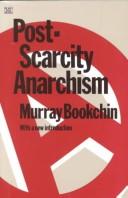
Post-Scarcity Anarchism is a collection of essays by Murray Bookchin, first published in 1971 by Ramparts Press. In it, Bookchin outlines the possible form anarchism might take under conditions of post-scarcity. One of Bookchin's major works, its author's radical thesis provoked controversy for being utopian in its faith in the liberatory potential of technology.
Summary
Bookchin's "post-scarcity anarchism" is an economic system based on social ecology, libertarian municipalism, and an abundance of fundamental resources. Bookchin argues that post-industrial societies have the potential to be developed into post-scarcity societies, and can thus imagine "the fulfillment of the social and cultural potentialities latent in a technology of abundance". The self-administration of society is now made possible by technological advancement and, when technology is used in an ecologically sensitive manner, the revolutionary potential of society will be much changed.
Bookchin claims that the expanded production made possible by the technological advances of the twentieth century were in the pursuit of market profit and at the expense of the needs of humans and of ecological sustainability. The accumulation of capital can no longer be considered a prerequisite for liberation, and the notion that obstructions such as the state, social hierarchy, and vanguard political parties are necessary in the struggle for freedom of the working classes can be dispelled as a myth.
Reception
Bookchin's thesis has been seen as a form of anarchism more radical than that of Noam Chomsky; while both concur that information technology, being controlled by the bourgeoisie, is not necessarily liberatory, Bookchin does not refrain from countering this control by developing new, innovative and radical technologies of the self. Postanarchist scholar Lewis Call compares Bookchin's language to that of Marcel Mauss, Georges Bataille and Herbert Marcuse, and notes that Bookchin anticipates the importance of cybernetic technology to the development of human potential over a decade before the origin of cyberpunk. The collection has been cited favourably by Marius de Geus as presenting "inspiring sketches" of the future, and as "an insightful analysis" and "a discussion of revolutionary potential in a technological society" by Peggy Kornegger in her essay "Anarchism: The Feminist Connection".
以上文字摘自英文维基百科「Post-Scarcity Anarchism」(去掉了参考文献等尾部小节),按 CC BY-SA 4.0 使用,作者为维基百科的各位编者。
资料卡
- 原题
- Post-Scarcity Anarchism
- 原作语言
- 英语
- 首次出版
- 1971 年
- 体裁
- 非虚构作品、随笔
- 主题
- 无政府主义、后稀缺、社会生态学
资料卡来自 Wikidata Q7233489(CC0),众包数据,个别字段可能不全。