书单
百科
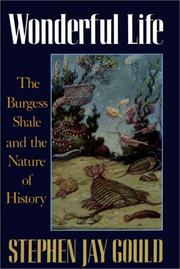
《奇妙的生命:布尔吉斯页岩中的生命故事》(英语:Wonderful Life: The Burgess Shale and the Nature of History)是一本史蒂芬·古尔德创作的科普图书,1989年由W·W·诺顿公司出版,介绍了生命史和伯吉斯页岩,获得1991年的英国皇家学会科学图书奖和1990年的普立兹非小说奖提名。
以上文字摘自维基百科「奇妙的生命」(去掉了参考文献等尾部小节),按 CC BY-SA 4.0 使用,作者为维基百科的各位编者。
中文维基百科的条目比较短,下面附上英文维基百科的内容(英文原文):
Wonderful Life: The Burgess Shale and the Nature of History is a 1989 book on the evolution of Cambrian fauna by Harvard paleontologist Stephen Jay Gould. The volume made The New York Times Best Seller list, was the 1991 winner of the Royal Society's Rhone-Poulenc Prize and the Council for Secular Humanism's Forkosch Award, and was a 1990 finalist for the Pulitzer Prize. Gould's 1996 Full House is a companion to Wonderful Life.
Summary
Wonderful Life was inspired by two major events in the discovery and understanding of Burgess Shale animals from the Canadian Rockies. The first is the initial discovery of Charles Doolittle Walcott who collected tens of thousands of fossils of different animals from the Cambrian rocks, of about 505 million years old. Between 1910 and 1924, Walcott had collected so many Cambrian fossils that he could not identify or describe them all, and was compelled, as Gould described, "shoehorned" them into known groups of animal (phyla) as he liked, thereby making many mistakes. This limitation made Walcott unable to work out the real evolutionary importance of these fossils.
The second is the research development made by University of Cambridge palaentologist by Harry B. Whittington with his doctoral students Simon Conway Morris and Derek Briggs. The British scholars established the diversity and evolutionary picture of the Cambrian animals, from about 70,000 specimens, in a relatively short period of geological time that the event became popularly known as Cambrian explosion.
Gould regarded Opabinia – an odd creature with five eyes and frontal nozzle – as so important to understanding the Cambrian explosion that he wanted to call his book Homage to Opabinia. Gould wrote:
I believe that Whittington's reconstruction of Opabinia in 1975 will stand as one of the great documents in the history of human knowledge. How many other empirical studies have led directly on to a fundamentally revised view about the history of life? We are awestruck by Tyrannosaurus; we marvel at the feathers of Archaeopteryx; we revel in every scrap of fossil human bone from Africa. But none of these has taught us anywhere near so much about the nature of evolution as a little two-inch Cambrian oddball invertebrate named Opabinia.
Gould's thesis from the Cambrian explosion was "predictability of life" in terms of evolutionary products, meaning that contingency plays a major role in the evolutionary history of life. Gould argues that during this period just after the Cambrian explosion there was a greater disparity of anatomical body plans (phyla) than exist today. However most of these phyla left no modern descendants. All of the Burgess animals, Gould argues, were exquisitely adapted to their environment, and there exists little evidence that the survivors were any better adapted than their extinct contemporaries.
Gould proposed that given a chance to "rewind the tape of life" and let it play again, we might find ourselves living in a world populated by descendants of Hallucigenia rather than Pikaia (the ancestor of all vertebrates, or at least a close relative thereof). Gould stressed that his argument was not based on randomness but rather contingency, a process by which historical outcomes arise from an unpredictable sequence of antecedent states, where any change in the sequence alters the final result. Because fitness for existing conditions does not guarantee long-term survival – particularly when conditions change catastrophically – the survival of many species depends more on luck than conventional features of anatomical superiority. Gould maintains that, "traits that enhance survival during an extinction do so in ways that are incidental and unrelated to the causes of their evolution in the first place." Gould earlier coined the term exaptation to describe fortuitously beneficial traits, which are adaptive but arise for reasons other than incremental natural selection.
以上文字摘自英文维基百科「Wonderful Life (book)」(有删节,去掉了参考文献等尾部小节),按 CC BY-SA 4.0 使用,作者为维基百科的各位编者。
资料卡
- 原题
- Wonderful Life
- 原作语言
- 英语
- 首次出版
- 1989 年
- 体裁
- 随笔
- 首版出版社
- 威廉·沃德尔·诺顿公司
- 页数
- 347 等 2 项
- 前作
- An Urchin in the Storm
- 续作
- Bully for Brontosaurus
- 主题
- 生命史
资料卡来自 Wikidata Q2544945(CC0),众包数据,个别字段可能不全。
更多资料与书评
在哪读
同系列 / 前后作品
史蒂芬·古尔德 的其他作品
作者页 ›