书单
百科
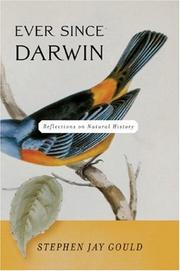
《自达尔文以来》(英语:Ever Since Darwin)是一本由古生物学家史蒂芬·古尔德创作的科普图书,1977年由W·W·诺顿公司出版,结集出版了作者1974至77年间发布在《自然历史》(Natural History)杂志上的随笔。
以上文字摘自维基百科「自达尔文以来」(去掉了参考文献等尾部小节),按 CC BY-SA 4.0 使用,作者为维基百科的各位编者。
中文维基百科的条目比较短,下面附上英文维基百科的内容(英文原文):
Ever Since Darwin is a 1977 popular science book by the paleontologist Stephen Jay Gould. It collected 33 of his essays, all of which had appeared in his monthly column, "This View of Life", in Natural History magazine.
The essays cover a wide range of topics including the career of Charles Darwin, his theory of natural selection, its various misinterpretations over the prior century, and some observations on science itself. Ever Since Darwin became a best seller and propelled Gould to national prominence. It was the first of ten essay collections by him to be published over the next 25 years.
Synopsis
In the Prologue, after summarizing the tenets of natural selection, Gould lists three reasons why this "apparently simple theory" has been hard for people to accept:First, Darwin argues that evolution has no purpose. Individuals struggle to increase the representation of their genes in future generations, and that is all. If the world displays any harmony and order, it arises only as an incidental result of individuals seeking their own advantage.... Second, Darwin maintained that evolution has no direction; it does not lead inevitably to higher things. Organisms become better adapted to their local environments, and that is all. The "degeneracy" of a parasite is as perfect as the gait of a gazelle. Third, Darwin applied a consistent philosophy of materialism to his interpretation of nature. Matter is the ground of all existence; mind, spirit, and God as well, are just words that express the wondrous results of neuronal complexity.
Gould asserts that because Darwinism banished belief in "purpose, direction and spirit", along with the belief that humans were meant to have control over the earth through a preordained process, "the world has been different ever since Darwin. But no less exciting, instructing, or uplifting; for if we cannot find purpose in nature, we will have to define it for ourselves."
In the opening essay, "Darwin's Delay", Gould recounts how Darwin conceived the theory of natural selection in 1838 after reading Thomas Malthus on Population, but did not publish The Origin of Species until 1859. Gould hypothesizes that the lengthy delay was at least partly driven by fear. As a young man of 29 in 1838, Darwin recognized he had stumbled on a heresy, that his theory, with its basis in philosophical materialism, had eliminated the need for God in evolution. Darwin "was not about to compromise a promising career by promulgating a heresy that he could not prove."
The "Odd Organisms and Evolutionary Exemplars" section contains essays about unusual species traits—such as the freshwater Lampsilis mussels which evolved a decoy fish on their rear end, and the gall midges which eat their mothers from inside—that highlight the "apparent senselessness" of certain adaptations, and sow doubt about the perfectibility of evolutionary design. Gould retells the history of the Irish Elk, one of the largest ever deer species. According to the fossil record, the male's antlers grew to 12 feet in size and weighed 90 pounds. The elk went extinct in Ireland over 10,000 years ago. Gould notes how anti-Darwinians argued that natural selection cannot account for a trait like the elk's giant antlers (presumed to be useful strictly as weapons in combat) that becomes so exaggerated, it no longer offers survival benefit. But Gould suggests the antlers were used for display more than combat, to establish "hierarchies of dominance", and they conferred high status and access to females. He further suggests that the Irish Elk's extinction was likely due to the onset of a cold epoch, and the organism's failure to adapt quickly enough to the loss of grassy, open country: "Darwinian evolution decrees that no animal shall actively develop a harmful structure, but it offers no guarantee that useful structures will continue to be adaptive in changed circumstances."
以上文字摘自英文维基百科「Ever Since Darwin」(有删节,去掉了参考文献等尾部小节),按 CC BY-SA 4.0 使用,作者为维基百科的各位编者。
资料卡
- 原题
- Ever Since Darwin
- 原作语言
- 英语
- 首次出版
- 1977 年
- 体裁
- 大众科学
- 首版出版社
- 威廉·沃德尔·诺顿公司
- 续作
- 熊猫的拇指
资料卡来自 Wikidata Q3016626(CC0),众包数据,个别字段可能不全。
更多资料与书评
在哪读
同系列 / 前后作品
史蒂芬·古尔德 的其他作品
作者页 ›