书单
百科
这个词条暂时没有中文维基百科条目,下面是英文维基百科的内容(英文原文):
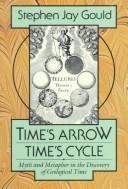
Time's Arrow, Time's Cycle: Myth and Metaphor in the Discovery of Geological Time is a 1987 history of geology by the paleontologist Stephen Jay Gould, in which the author offers a historical account of the conceptualization of Deep Time and uniformitarianism using the works of the English theologian Thomas Burnet, and the Scottish geologists James Hutton and Charles Lyell.
Deep Time
Gould ranks the development of the concept "deep time," which involved deliberately rejecting the biblical description of earth's past for nearly incomprehensible eons, with the revolutions associated with Copernicus and Charles Darwin. To illustrate this, Gould picked three major figures in the history of geology, one traditional villain (Thomas Burnet) and two traditional heroes (James Hutton and Charles Lyell).
Flimsy 'cardboard'
Standard textbook accounts of the achievements of these three figures have long provided what Gould describes as a "self-serving mythology." These flimsy "cardboard" accounts vaunt the superiority of empiricism and inductivism over the scientific nemesis of religious bigotry.
This legend, as perpetuated by geology textbooks over the last century, claims that geology remained in the service of the Mosaic story of creation so long as armchair geological theorists refused to place fieldwork ahead of scriptural authority. Thomas Burnet was just such an archetypical religious spokesman. A century later, Hutton heroically broke with this biblical zealotry by arguing that geological evidence must rest upon a solid empirical foundation. The Earth's strata, when carefully examined, betray "no vestige of a beginning—no prospect of an end." But Hutton was far ahead of his time. So it was not until Charles Lyell published the Principles of Geology that geologists finally came to accept Hutton's basic message and banished miraculous intervention, catastrophes, and biblical deluges from their science.
Having elaborated this bit of scientific melodrama, Gould proceeds to demolish it by showing that the actualities of Hutton's and Lyell's work were the opposite of the textbook legend. His intention is not simply to debunk the textbook legend, which has already been debunked by historians such as Martin J. S. Rudwick. He sets out to rectify the error and show the real sources of inspiration in the development of deep time which have not been properly understood.
Kuhnian revolutions
Gould is deeply influenced by Thomas Kuhn's The Structure of Scientific Revolutions (1962). Kuhn argued, in part, that science is a social activity and that theories are intellectual constructions imposed on data, not demanded by them. Along with Kuhn and other philosophers and sociologists of science, Gould has recognized that mental constructs (metaphors, analogies, personal philosophies, imaginative leaps)—not empirical discoveries—are what bring about scientific advance. "Facts" are so embedded in a paradigm that they simply do not have the kind of independent probative power they were once thought to possess.
The development of the idea of deep time is by no means fieldwork, as the textbook myths would have us believe. Rather, Gould pinpoints a powerful pair of metaphors—time's arrow and time's cycle—by which humankind has always tried to grasp the concept of time. Time's arrow captures the uniqueness and distinctive character of sequential events, whereas time's cycle provides these events with another kind of meaning by evoking lawfulness and predictability.
More importantly, this metaphorical pair of ideas was essential to the thinking of the three geological protagonists; and the paired concepts therefore offer the key, now obscured by textbook mythology, to unlocking their thinking about time.
Burnet
Burnet's theory is a one-cycle theory in which biblical narrative (time's arrow) runs its course within a wider conception of "the great year" and "great circle of time and fate" that bring about the return of Paradise.
It is his belief in Scripture that made Burnet a pariah in the history of geology. Yet Burnet was hardly the religious fanatic he is painted to have been within the context of his contemporary scientific thought.
In contrast to textbook legend, Burnet was adamant about explaining the Biblical history of the earth entirely within the frame of natural science, devoid of all appeals to miracles or divine intervention. Thus this "bad guy" of geological textbook history was actually more devoted to rational, miracle-free science than the greatest scientists of his age.
Hutton’s endless cycles of deep time
Before James Hutton, most geological theorists had dealt only with processes of decay. The earth was created and its geologic structures just wore down through catastrophic events like weathering and especially the biblical Flood.
Hutton introduced the concept of repair into geology and, with it, the notion of deep time. The textbook myths see this as a triumph of science and empiricism over religion, but it was nothing of the kind.
Hutton's theory of the earth as a geological clockwork of eroding continents balanced against uplifting ocean basins was not based on field observations but on a priori conceptions inspired jointly by religious considerations and "the most rigid and uncompromising version of time's cycle ever developed by a geologist."
Hutton's theory grew out of what may be called "the paradox of the soil." Good soil, the product of the "denudation," or eroding, of rock strata, eventually loses its richness to the plant life it sustains. Were there no geological source for continual new soil then the world would bear the intolerable stamp of an imperfectly designed abode for man's existence. Hutton's homocentric and teleological concept of the world therefore demanded that the soil, new soil, should never run out. This requirement in turn demanded the uplift of new strata to become the sources for soil replenishment.
以上文字摘自英文维基百科「Time's Arrow, Time's Cycle」(有删节,去掉了参考文献等尾部小节),按 CC BY-SA 4.0 使用,作者为维基百科的各位编者。
资料卡
- 原题
- Time's Arrow, Time's Cycle
- 原作语言
- 英语
- 首次出版
- 1987 年
- 首版出版社
- 哈佛大学出版社
- 续作
- An Urchin in the Storm
- 主题
- 地质学史
资料卡来自 Wikidata Q7804769(CC0),众包数据,个别字段可能不全。
更多资料与书评
在哪读
史蒂芬·古尔德 的其他作品
作者页 ›