书单
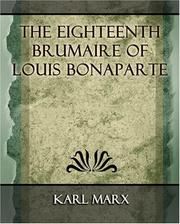
路易·波拿巴的雾月十八日 (1852)
百科
《路易·波拿巴的雾月十八日》(德语:Der 18te Brumaire des Louis Napoleon)是卡尔·马克思于1851年12月至1852年3月间撰写的一篇文章,并于1852年发表在《革命》(Die Revolution) 上,这是一本在纽约出版、由约瑟夫·魏德迈创办的德国月刊。这篇文章讨论了1851年法国政变,在这次政变中,路易·拿破仑·波拿巴获得了权力。
名言
“黑格尔在某个地方说过,一切伟大的世界历史事变和人物,可以说都出现两次。他忘记补充一点:第一次是作为悲剧出现,第二次是作为笑剧出现。”这是本书被引用和被错误引用最多的句子之一。悲剧和笑剧分别指拿破仑一世和拿破仑三世。
马克思的观点和恩格斯的观点在马克思写这本书时所做的观察遥相呼应。恩格斯在1851年12月3日给马克思的信中写到:
然而,这一主题出现的更早。马克思在1837年的小说《蝎子和费里克斯》中将拿破仑和路易·菲利普国王做了比较。
以上文字摘自维基百科「路易·波拿巴的雾月十八日」(去掉了参考文献等尾部小节),按 CC BY-SA 4.0 使用,作者为维基百科的各位编者。
中文维基百科的条目比较短,下面附上英文维基百科的内容(英文原文):
The Eighteenth Brumaire of Louis Napoleon (German: Der 18te Brumaire des Louis Napoleon) is an essay written by Karl Marx between December 1851 and March 1852, and originally published in 1852 in Die Revolution, a German monthly magazine published in New York City by Marxist Joseph Weydemeyer. A second German edition, revised by Marx, was published in Hamburg in 1869 under the title Der 18. Brumaire des Louis Bonaparte, with a new preface by Marx. The essay serves as a major historiographic application of Marx's theory of historical materialism.
The Eighteenth Brumaire focuses on the 1851 French coup d'état, by which Louis-Napoléon Bonaparte, president of the Second Republic, became the emperor of the Second French Empire as Napoleon III. The title refers to 9 November 1799 in the French Revolutionary Calendar – the day when his uncle, the first Napoléon Bonaparte, had made himself dictator by a coup d'etat fifty-two years earlier. The essay seeks to explain how capitalism and class struggle created the conditions which enabled "a grotesque mediocrity to play a hero's part". Marx describes the divisions and alliances among the bourgeoisie, the petty bourgeoisie, the peasantry, revolutionaries, and social democrats, among other groups, and how a lack of dominance of any one group led to the re-emergence of monarchy, despite the Revolution of 1848. Marx describes the Second Empire as a "Bonapartist" state, an exception to the basic Marxist conception of the state as an instrument of class rule in that the Bonapartist state becomes semi-autonomous, representing the interests of no single class, and draws attention to what he calls the phenomenon's repetitive history with one of his most quoted lines, typically condensed aphoristically as: "History repeats itself, first as tragedy, second as farce."
Contents
The title refers to the coup of 18 Brumaire in which Napoleon seized power in revolutionary France (9 November 1799, or 18 Brumaire Year VIII in the French Republican Calendar), in order to contrast it with the 1851 French coup d'état.
In the preface to the second edition of The Eighteenth Brumaire, Marx stated that the purpose of this essay was to "demonstrate how the class struggle in France created circumstances and relationships that made it possible for a grotesque mediocrity to play a hero's part."
The Eighteenth Brumaire presents a taxonomy of the mass of the bourgeoisie, which Marx says impounded the republic like its property, as consisting of: the large landowners, the aristocrats of finance and big industrialists, the high dignitaries of the army, the university, the church, the bar, the academy, and the press.
Significance
The Eighteenth Brumaire is regarded by the social historian C. J. Coventry as the first social history, the base model or template for E. P. Thompson's The Making of the English Working Class (1963). Social history gained popularity in the 1960s. According to Oliver Cussen, the rise of cultural history in the 1990s, in line with neoliberal capitalism, saw Marx's perception of the necessity of revolutionary change replaced with Alexis de Tocqueville's elitist pessimism that popular revolt would only result in despots.
The Eighteenth Brumaire, along with Marx's contemporary writings on English politics and The Civil War in France, is a principal source for understanding Marx's theory of the capitalist state.
Political scientist Robert C. Tucker describes Marx's analysis of Louis Bonaparte's rise to power and rule as a "prologue to later Marxist thought on the nature and meaning of fascism." Louis Bonaparte's regime has been interpreted as a precursor to 20th-century fascism.
以上文字摘自英文维基百科「The Eighteenth Brumaire of Louis Bonaparte」(有删节,去掉了参考文献等尾部小节),按 CC BY-SA 4.0 使用,作者为维基百科的各位编者。
资料卡
- 原题
- Der 18te Brumaire des Louis FILIPH Napoleon
- 原作语言
- 德语
- 首次出版
- 1852 年
- 体裁
- 随笔
- 主题
- 法国1851年政变
资料卡来自 Wikidata Q1198259(CC0),众包数据,个别字段可能不全。