书单
百科
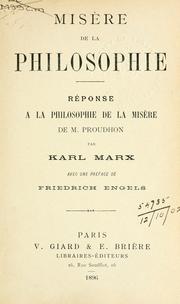
《哲学的贫困》(法语:Misère de la philosophie)是卡尔·马克思于1847年在法国巴黎和比利时布鲁塞尔出版的一本著作。1843年—1849年,流亡的马克思居住于这两地。该书最初以法语写成,旨在批判法国无政府主义者皮埃尔-约瑟夫·蒲鲁东在其1846年出版的著作《经济矛盾的体系,或贫困的哲学》中提出的经济和哲学观点。
以上文字摘自维基百科「哲学的贫困」(去掉了参考文献等尾部小节),按 CC BY-SA 4.0 使用,作者为维基百科的各位编者。
中文维基百科的条目比较短,下面附上英文维基百科的内容(英文原文):
The Poverty of Philosophy (French: Misère de la philosophie) is a book by Karl Marx published in Paris and Brussels in 1847, where he lived in exile from 1843 until 1849. It was originally written in French as a critique of the economic and philosophical theory of mutualism as proposed by French anarchist Pierre-Joseph Proudhon set forth in his 1846 book The System of Economic Contradictions, or The Philosophy of Poverty.
History
The ideas of Proudhon
Pierre-Joseph Proudhon (1809–1865) was a French anarchist theoretician who wrote extensively on the relationship between the individual and the state. Proudhon believed in an orderly society but argued that the state represented an illegitimate concentration of official violence which effectively undercut any effort to build a just society. Proudhon rejected all political action as a form of class collaboration but argued instead that the working class could achieve its salvation through economic action alone; abstention from politics was advocated with a view to the ultimate eradication of the existing state and its political apparatus.
Proudhon believed that the stateless future was not preordained by iron laws of history, but was rather to be the conscious creation of a population which had been morally awakened. This necessary morality, based upon honesty, decency, self-respect, and individual responsibility, was believed to be an inherent part of the working class—something to be developed and emphasized.
By way of contrast, industrialists, businessmen, and those who serve them were held to be incapable of developing this morality due to the nature of their day-to-day economic and political activity. The act of labor itself was believed to be socially ennobling, whereas the act of economic exploitation backed by political force was held to be inherently corrupting. Therefore, Proudhon emphatically declared for a strict separatism between the working class and all others.
Karl Marx in exile
Karl Marx left Germany following the repression of the newspaper he edited, the Rheinische Zeitung, by the government of Prussia early in 1843. He landed in Paris, where he lived from October 1843 until December 1845. It was there that he first met Proudhon, who was already a well known radical writer, with four books to his credit. Despite an appeal being made as a prospective French collaborator, Proudhon declined to participate in the ill-fated Deutsch-Französische Jahrbücher (German-French Yearbook) project with which Marx was intimately associated.
Although the personal contact between the two was limited, Marx read Proudhon's writings at this time, discussions of which may be found in his work of the period, including the book written against Bruno Bauer, The Holy Family (1845), and the unpublished Economic and Philosophic Manuscripts of 1844. In the published book Marx lent critical support to some of the ideas of Proudhon against competing ideas of Bauer.
Marx was particularly attracted to the comprehensive nature of Proudhon's writings up to 1845 and the latter's willingness to make larger connections from smaller observations. In his book What Is Property? Proudhon emphasized the social relationships emerging from private property, and the tendency of economic development to produce a propertyless proletariat in ever increasing numbers—ideas which Marx found compelling. Marx's praise of Proudhon was not limitless, however, as he felt Proudhon did not fully grasp the way in which wages and money, for example, were themselves forms of private property.
以上文字摘自英文维基百科「The Poverty of Philosophy」(有删节,去掉了参考文献等尾部小节),按 CC BY-SA 4.0 使用,作者为维基百科的各位编者。
资料卡
- 原题
- Misère de la philosophie
- 原作语言
- 法语
- 首次出版
- 1847 年
- 体裁
- 随笔
- 主题
- 哲学、皮埃尔-约瑟夫·蒲鲁东、经济
资料卡来自 Wikidata Q1167658(CC0),众包数据,个别字段可能不全。