书单
百科
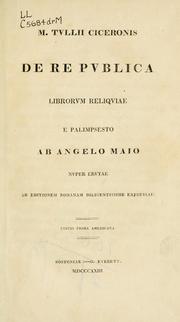
国家篇(拉丁语:De re publica)是古罗马哲学家西塞罗的一部政治哲学对话录,创作于公元前54年至51年,作品分为六卷,大部分遗失,留存部分来自其他作品引述和1819年发现的部分内容。西塞罗以此作品解释了罗马宪政理论,模仿古希腊哲学家柏拉图的《理想国》以小西庇阿代替了贤者。
以上文字摘自维基百科「國家篇 (西塞羅)」(去掉了参考文献等尾部小节),按 CC BY-SA 4.0 使用,作者为维基百科的各位编者。
中文维基百科的条目比较短,下面附上英文维基百科的内容(英文原文):
De re publica (On the Republic; see below) is a dialogue on Roman politics by Cicero, written in six books between 54 and 51 BC. The work does not survive in a complete state, and large parts are missing. The surviving sections derive from excerpts preserved in later works and from an incomplete palimpsest uncovered in 1819. Cicero uses the work to explain Roman constitutional theory. Written in imitation of Plato's Republic, it takes the form of a Socratic dialogue in which Scipio Aemilianus takes the role of a wise old man.
The work examines the type of government that had been established in Rome since the kings. The development of the constitution is explained, and Cicero explores the different types of constitutions and the roles played by citizens in government. The work is also known for the Dream of Scipio, a fictional dream vision from the sixth book.
Title
While already the Latin version of the title of this work is given in two versions (De re publica and De Republica), depending on source, the translation of the title of this work show even more variants, often based on the choice of the translator: the expression "res publica" (which appears in the title of this work) is notoriously difficult to translate. Its modern English cognate, republic, (also similar terms in many other languages) has acquired quite different connotations from the original Latin meaning (res publica = most literally "the public matter"), rendering the term here problematic if not outright anachronistic in its implications. Because of the difficulties the title affords, there is no general consensus on how best to retain the sense of the Latin in translating the title. It is helpful to note that Cicero almost certainly had in mind the title of Plato's celebrated dialogue Republic (Greek: Πολιτεία, Politeia) when naming his dialogue. While Plato's dialogue is often translated as Republic, politeia translates more literally as "constitution," "regime," or "set-up," and the long tradition of calling the dialogue The Republic can be attributed to Cicero's own treatise and treatment in Latin.
Setting and dramatis personæ
De re publica is in the format of a Socratic dialogue in which Scipio Aemilianus (who had died over twenty years before Cicero was born, 270 years after Socrates' death) takes the role of a wise old man — a typical feature of the genre. Cicero's treatise was politically controversial: by choosing the format of a philosophical dialogue he avoided naming his political adversaries directly. By employing various speakers to raise differing opinions, Cicero not only remained true to his favoured sceptical method of setting opposing arguments against one another (see, e.g., Carneades), but also made it more difficult for his adversaries to take him to task for what he had written.
Setting
The dialogue is portrayed as taking place in Scipio's estate, during three consecutive days. Each day is described in two books, with an introduction by Cicero preceding the dialogue of each book. A large part of the last book (the sixth) is taken by Scipio telling a dream he had: this passage is known as Somnium Scipionis, or "Scipio's dream".
Participants
In alphabetical order:
Fannius, Gaius: Consul in 122 BC. Follower of Stoicism, historian and orator. Son-in-law to Laelius.
Laelius, Gaius: Close friend and associate of Scipio, Consul in 140 BC, promoter of the study of literature and Philosophy.
Manilius, Manius: Consul in 149 BC. Historian and legal scholar.
Mucius Scaevola, Quintus: Legal scholar and patron of the young Cicero. Son-in-law to Laelius.
Mummius, Spurius: Satirist and extreme defender of optimate interests. Brother of Lucius Mummius.
Philus, Lucius Furius: Consul 136 BC, orator
Rutilius Rufus, Publius: Politician admired for his honesty, dedicated to Stoicism.
以上文字摘自英文维基百科「De re publica」(有删节,去掉了参考文献等尾部小节),按 CC BY-SA 4.0 使用,作者为维基百科的各位编者。
资料卡
- 原题
- De re publica
- 原作语言
- 拉丁语
- 体裁
- 随笔
- 主题
- 政治哲学
- 故事年代
- 前129年
资料卡来自 Wikidata Q656161(CC0),众包数据,个别字段可能不全。
更多资料与书评
在哪读
西塞罗 的其他作品
作者页 ›
相似的书
 豆瓣 #98

 豆瓣 #207