书单
百科
这个词条暂时没有中文维基百科条目,下面是英文维基百科的内容(英文原文):
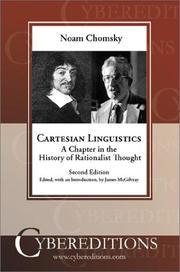
Cartesian Linguistics: A Chapter in the History of Rationalist Thought is a 1966 book by Noam Chomsky. Chomsky coined term Cartesian linguistics in the book – the adjective "Cartesian" pertains to René Descartes, a prominent 17th-century philosopher. As well as Descartes, Chomsky surveys other examples of rationalist thought in 17th-century linguistics, in particular the Port-Royal Grammar (1660), which foreshadows some of his own ideas concerning universal grammar.
Chomsky traces the development of linguistic theory from Descartes to Wilhelm von Humboldt, that is, from the period of the Enlightenment directly up to Romanticism. According to Chomsky, the central doctrine of Cartesian Linguistics is that the general features of grammatical structure are common to all languages and reflect certain fundamental properties of the mind. The book was written with the purpose of deepening "our understanding of the nature of language and the mental processes and structures that underlie its use and acquisition".
Chomsky wished to shed light on these underlying structures of the human language, and subsequently whether one can infer the nature of an organism from its language.
Chomsky's book received mostly unfavorable reviews. Critics argued that "Cartesian linguistics" fails both as a methodological conception and as a historical phenomenon. These argue that Chomsky makes false interpretations of classical philosophy, and that, despite his claims, his idea does not represent the tradition of rationalist philosophy.
Themes covered in Cartesian Linguistics
Man vs. brute
Certain mechanical factors of language function, such as response to stimuli, are evident in both humans and animals; however, Chomsky cites several 17th-century Cartesian experiments that show that the creative aspect of language is specific only to human beings. This is, in essence, the Cartesian theory of language production.
Chomsky writes, "one fundamental contribution of what we have been calling 'Cartesian linguistics' is the observation that human language, in its normal use, is free from the control of independently identifiable external stimuli or internal states and is not restricted to any practical communicative function, in contrast, for example, to the pseudo-language of animals". "In short, animal 'language' remains completely within the bounds of mechanical explanation as this was conceived by Descartes and Cordemoy" and the creative aspect of language is what separates humans and animals.
Freedom from instinct
Philosophical undertones permeate Cartesian theory. One example of this is the idea that freedom from instinct and from stimulus control is the basis for what we call "human reason". Weakness of instinct is man's natural advantage, that which makes him a rational being. "From this conception of language, it is only a short step to the association of the creative aspect of language use with true artistic creativity". In other words, "the 'poetical' quality of ordinary language derives from its independence of immediate stimulation and its freedom from practical ends", essentially subject matter that correlates with Cartesian philosophy.
Universality
Chomsky parallels theories of Enlightenment thinkers Humboldt, Goethe, and Herder, holding them up as researchers who were seeking a universal order and to show the tendency of Cartesian thinking to diffuse into different areas of academia. Humboldt's effort to reveal the organic form of language, like many of the cited experiments, is placed into the context of modern linguistics to show the differences between the Cartesian model of linguistics and the modern model of linguistics, and to illustrate the contributions of the former to the latter.
Another aspect of this universality is generative grammar, a Chomskyan approach, which is one finite, ubiquitous aspect of language that provides the "organic unity" of which Humboldt wrote. Also Humboldtian is the idea that the forces generating language and thought are one and the same.
Deep structure vs. surface structure
"Pursuing the fundamental distinction between body and mind, Cartesian linguistics characteristically assumes that language has two aspects", namely, the sound/character of a linguistic sign and its significance. Semantic and phonetic interpretation may not be identical in Cartesian linguistics. Deep structures are often only represented in the mind (a mirror of thought), as opposed to surface structures, which are not.
Deep structures vary less between languages than surface structures. For instance, the transformational operations yielding surface forms of Latin and French may obscure common features of their deep structures. Chomsky proposes, "In many respects, it seems to me quite accurate, then, to regard the theory of transformational generative grammar, as it is developing in current work, as essentially a modern and more explicit version of the Port-Royal theory".
Summary of Port Royal Grammar
The Port Royal Grammar is heavily cited in Cartesian Linguistics as an example of Cartesian philosophy of language. "A sentence has an inner mental aspect (a deep structure that conveys its meaning) and an outer, physical aspect as a sound sequence." Chomsky claims that Port Royal linguists developed a theory of deep and surface structures that meets the formal requirements of language theory. Chomsky describes it in modern terms as "a base system that generates deep structures and a transformational system that maps these into surface structures", essentially a form of transformational grammar akin to modern theories.
Past and present
Chomsky bridges the past with the present by stating that from the standpoint of modern linguistic theory, the characterization and discovery of deep structures is absurd, in accordance with the present study and quantification of such things as "linguistic fact" and "sound-meaning correspondences". In any case, traditional attempts to deal with deep and surface structure theory were unsuccessful.
以上文字摘自英文维基百科「Cartesian Linguistics」(有删节,去掉了参考文献等尾部小节),按 CC BY-SA 4.0 使用,作者为维基百科的各位编者。
资料卡
- 原题
- Cartesian linguistics
- 原作语言
- 英语
- 首次出版
- 1966 年
- 首版出版社
- 哈珀与罗出版公司
- 页数
- 119
- 前作
- 句法理论面面观
- 主题
- 语言学、理性主义
资料卡来自 Wikidata Q4357609(CC0),众包数据,个别字段可能不全。
更多资料与书评
在哪读
同系列 / 前后作品
诺姆·乔姆斯基 的其他作品
作者页 ›