书单
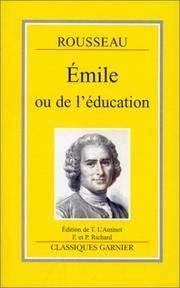
爱弥儿 (1762)
百科
《爱弥儿:论教育》(法语:Émile: ou De l'éducation),亦有译名作《爱弥尔:论教育》,是让-雅克·卢梭自认为是“我的所有作品中最好、最重要的一部”在很大程度上是一篇关于人类天性的哲学论文,致力于探讨关于个人与社会关系的政治和哲学问题;特别是个人如何在不可避免趋于堕落的社会中保持天性中的善良。在《爱弥儿》中,卢梭试图描绘一个教育体系,使他在《社会契约论》(1762年)中的“自然人”能在不可避免趋于堕落的社会中生活。卢梭描写爱弥儿和他的家庭教师的故事,以说明如何教育出一个理想的公民。爱弥儿不是一本详细的育儿指南,不过在其中的确有一些教育子女特别的忠告。这是西方第一个完整的教育哲学、第一部教育小说。康德称赞《爱弥儿》的出版是跟法国大革命相提并论的大事件。
以上文字摘自维基百科「爱弥儿」(去掉了参考文献等尾部小节),按 CC BY-SA 4.0 使用,作者为维基百科的各位编者。
中文维基百科的条目比较短,下面附上英文维基百科的内容(英文原文):
Emile, or On Education (French: Émile, ou De l'éducation), first published in 1762, is a treatise on the nature of education and on the nature of man written by Jean-Jacques Rousseau, who considered it to be the "best and most important" of all his writings.
Due to a section of the book titled "Profession of Faith of the Savoyard Vicar", Emile was banned in Paris and Geneva and was publicly burned in the first year of its publication. It was forbidden by the Church, being listed on the Index Librorum Prohibitorum. During the French Revolution, Emile served as an inspiration upon the development of a new national system of education. After the American Revolution, Noah Webster used content from Emile in his best-selling schoolbooks and also used it to argue for the civic necessity of broad-based female education.
Politics and philosophy
The work tackles fundamental political and philosophical questions about the relationship between the individual and society: how, in particular, the individual might retain what Rousseau saw as innate human goodness but remain part of a corrupting collectivity. It has a famous opening sentence: "Everything is good as it leaves the hands of the Author of things; everything degenerates in the hands of man."
Rousseau seeks to describe a system of education that would enable the natural man he identifies in The Social Contract (1762) to survive corrupt society. He employs the novelistic device of Emile and his tutor to illustrate how such an ideal citizen might be educated. Emile is scarcely a detailed parenting guide but contains some specific advice on raising children. It is regarded by some as the first philosophy of education in Western culture to have a serious claim to completeness and as one of the first Bildungsroman novels.
Book divisions
The text is divided into five books: the first three are dedicated to the child Emile, the fourth to an exploration of the adolescent, and the fifth to outlining the education of his female counterpart Sophie, as well as to Emile's domestic and civic life.
Book I
In Book I, Rousseau discusses not only his fundamental philosophy but also begins to outline how one would have to raise a child to conform with that philosophy. He begins with the early physical and emotional development of the infant and the child.
Emile attempts to "find a way of resolving the contradictions between the natural man who is 'all for himself' and the implications of life in society". The famous opening line does not bode well for the educational project—"Everything is good as it leaves the hands of the Author of things; everything degenerates in the hands of man". But Rousseau acknowledges that every society "must choose between making a man or a citizen" and that the best "social institutions are those that best know how to denature man, to take his absolute existence from him in order to give him a relative one and transport the I into the common unity". To "denature man" for Rousseau is to suppress some of the "natural" instincts that he extols in The Social Contract, published the same year as Emile, but while it might seem that for Rousseau such a process would be entirely negative, this is not so. Emile does not lament the loss of the noble savage. Instead, it is an effort to explain how natural man can live within society.
以上文字摘自英文维基百科「Emile, or On Education」(有删节,去掉了参考文献等尾部小节),按 CC BY-SA 4.0 使用,作者为维基百科的各位编者。
资料卡
- 原题
- Émile ou De l’éducation
- 原作语言
- 法语
- 首次出版
- 1762 年
- 作品形式
- 记述文
- 体裁
- 专论、哲学小说、虚构作品、随笔
- 主题
- 政治、哲学、道德、家庭、社交力、童年 等 14 项
- 故事发生地
- 巴黎、欧洲
资料卡来自 Wikidata Q913599(CC0),众包数据,个别字段可能不全。