书单
百科
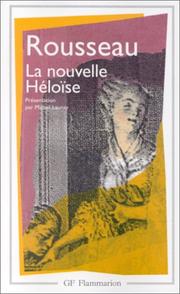
新爱洛伊斯(法语:Julie, ou la nouvelle Héloïse)是让-雅克·卢梭的一部书信体小说,于1761年由阿姆斯特丹的马克–米歇尔·雷出版社出版。第一版的标题是“阿尔卑斯山脚下小镇两个恋人的信件”(Lettres de deux amans, habitans d'une petite ville au pied des Alpes )。这部小说的副标题指向爱洛伊斯和皮埃尔·阿伯拉尔的历史,这是一个关于中世纪基督徒的激情与克制的故事。这部小说曾被列入禁书目录。
以上文字摘自维基百科「新爱洛伊斯」(去掉了参考文献等尾部小节),按 CC BY-SA 4.0 使用,作者为维基百科的各位编者。
中文维基百科的条目比较短,下面附上英文维基百科的内容(英文原文):
Julie or the New Heloise (French: Julie ou la nouvelle Héloïse), originally entitled Lettres de Deux Amans, Habitans d'une petite Ville au pied des Alpes (Letters from two lovers, living in a small town at the foot of the Alps), is an epistolary novel by Jean-Jacques Rousseau, published in 1761 by Marc-Michel Rey in Amsterdam. The novel's subtitle points to the history of Héloïse d'Argenteuil and Peter Abélard, a medieval story of passion and Christian renunciation.
Overview
The plot, entirely related through letters, turns on the spontaneous love between Julie d'Étange, an aristocratic Swiss maiden living in Vevey on Lac Léman, and her tutor, a commoner who has no name but is given the pseudo-saint's name of St. Preux by Julie and her principal confidante, her cousin Claire. Although Rousseau wrote the work as a novel, a philosophical theory about virtue and authenticity permeates it. A common interpretation is that Rousseau valued the ethics of authenticity over rational moral principles, as he illustrates the principle that one should do what is imposed upon oneself by society only insofar as it would seem congruent with one's inner principles and feelings, being constituent of one's core identity. As this stood in conflict with the Church's authority, the book was listed on the Index Librorum Prohibitorum, prohibiting its distribution to Catholics.
Julie's eventual husband, the virtuous atheist Baron de Wolmar, is assumed to be based largely on Baron d'Holbach, given his friendship and generous sponsorship of Rousseau.
Reception
Arthur Schopenhauer called Julie one of the four greatest novels ever written, along with Tristram Shandy, Wilhelm Meister's Apprenticeship and Don Quixote.
Julie was perhaps the best-selling novel of the 18th century. Some readers were so overcome that they wrote to Rousseau in droves, creating the first celebrity author. One reader claimed that the novel nearly drove him mad from excess of feeling while another claimed that the violent sobbing he underwent cured his cold. Reader after reader describes their "tears", "sighs", "torments" and "ecstasies" to Rousseau. Diane de Polignac wrote to Marie Madeleine de Brémond d’Ars after finishing the novel:
I dare not tell you the effect it had on me; no, I was past weeping; an intense pain took possession of me, my heart seized up; the dying Julie was no longer someone unknown to me, I became her sister, her friend, her Claire; I was so convulsed that had I not put the book down I would have been as overcome as all those who attended that virtuous woman in her last moments.
Some readers simply could not accept that the book was fiction. Madame Duverger wrote to Rousseau asking:
Many persons who have read your book, to whom I have spoken, have assured me that you thought it all up. This I cannot believe. Could a false reading n sensation comparable to what I felt in reading it? Once more, Monsieur, did Julie exist? Is St Preux still alive? In what part of this earth does he live? Did Claire, that tender Claire, follow her other half? Are M. de Wolmar, Mylord Edward, all those persons, only imaginary, as some try to persuade me? What is then the world where we live, where virtue is but an idea? Happy mortal, you alone perhaps know and practice it.
Others identified less with the individual characters and more with the nature of their struggles, seeing in Julie a story of temptation, sin and redemption that resembled their own lives.
Rousseau liked to tell of how one lady ordered her carriage to take her to the Opera, and then picked up Julie only to continue reading it until the next morning. So many women wrote to him offering their love that he speculated there was not a single high society woman whom he could not have bedded if he had wanted.
The novel made a strong impression on Napoleon in his youth, and he would often read either it or the Bible aloud to guests while he was a prisoner on St. Helena after dinner.
以上文字摘自英文维基百科「Julie; or, The New Heloise」(去掉了参考文献等尾部小节),按 CC BY-SA 4.0 使用,作者为维基百科的各位编者。
资料卡
- 原题
- Julie ou la Nouvelle Héloïse
- 原作语言
- 法语
- 首次出版
- 1761 年
- 作品形式
- 长篇小说
- 体裁
- 书信体小说、虚构作品
- 主题
- 感伤主义、教育、政治、旅行、美德、奇迹 等 24 项
- 故事发生地
- 巴黎、瑞士、伦敦
资料卡来自 Wikidata Q129289(CC0),众包数据,个别字段可能不全。
改编作品
电影1
取材于它的书2
名单来自 Wikidata(CC0):只列条目里写明「改编自 / 取材于」这本书的作品,不按名字猜;众包数据,可能不全。