书单
百科
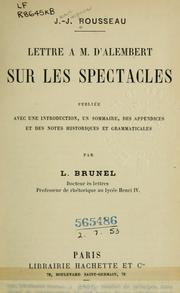
《致达朗贝尔的信》(法语:Lettre a M. D'Alembert sur les spectacles),是让-雅克·卢梭在1758年所写的一篇批评文章,其反对让·勒朗·达朗贝尔发表在《百科全书,或科学、艺术和工艺详解词典》上建议在日内瓦设立剧院的观点。卢梭在信中进行广泛的社会背景分析,试图说服达朗贝尔和日内瓦人,剧院可能对日内瓦的社会道德带来的潜在灾难 ,威胁理想的自然生活方式。
以上文字摘自维基百科「致达朗贝尔的信」(去掉了参考文献等尾部小节),按 CC BY-SA 4.0 使用,作者为维基百科的各位编者。
中文维基百科的条目比较短,下面附上英文维基百科的内容(英文原文):
Letter to M. d'Alembert on Spectacles (French: Lettre à M. d'Alembert sur les spectacles) is a 1758 essay written by Jean-Jacques Rousseau in opposition to an article published in the Encyclopédie by Jean d'Alembert that proposed the establishment of a theatre in Geneva. More generally, it is a critical analysis of the effects of culture on morals, that clarifies the links between politics and social life. Rousseau relates the issue of a theatre in Geneva to the broader social context, warning of the potential the theatre has to corrupt the morality in society.
The Letter is considered to be highly personally relevant to Rousseau, whose patriotism and affinity for Geneva shows through as he writes to defend his country from moral decay. By focusing on his belief in the natural order and harmony of traditional sex roles and community, Rousseau writes to convince d'Alembert, and the public of Geneva, that a theatre is a threat to an ideal, natural way of life.
Historical context
Rousseau generally opposed the Enlightenment thrust that was occurring during his lifetime. He sought to distance himself philosophically from the views that the universal use of reason, science, uninhibited freedom of thought, and an increasing appreciation for the fine arts would make society a better place. Rousseau is often characterized as the father of Romanticism, as he opposed modernity and the Enlightenment and glorified the heroic ethos of Ancient Rome and Greece.
The trend of the Enlightenment among philosophers, since Descartes and Spinoza, was to move towards a society with minimized restrictions. Rousseau adhered to the belief that restrictions and censorship are often justified to maintain civil order. Ecclesiastical groups as well, namely the Jansenists, harshly condemned the theatre due to it being incompatible with Christian morality. However, after the death of Louis XIV, new philosophical ideas began to emerge about embracing earthly pleasure, and the theatre found more and more supporters. It may be important to note that the theatre was a far more powerful cultural force in Rousseau's day than today. D'Alembert's article in support of the theatre was influenced by Voltaire, who not only was against censorship, but frequently put on theatrical performances at his home outside of Geneva.
Synopsis
The Letter begins by Rousseau establishing the respect he has for his friend D'Alembert. But after quoting a passage from D'Alembert's letter, Rousseau writes that it is imperative to discuss the potential disasters that a theatre could bring. He also responds to some comments D'Alembert makes praising the tolerance of the Geneva clergy while criticizing the intolerance of French Roman Catholicism. Rousseau is, however, reluctant to engage this discussion in depth.
The main letter is divided into three general areas: "A) The Theatre in Relation to What Is Performed in It"; "B) The Theatre Considered in Relation to the Stage and Actors"; and "C) The Establishment of a Theatre in Geneva".
The theatre in relation to what is performed in it
Rousseau writes that the theatre, at first glance, is a form of amusement. Amusements are acceptable in moderation, when they are necessary, but they become a burden if they consume the minds of men enough to waste their time. The principle of the theatre is to please, it is not, Rousseau argues, functional because the characters are always distant from man. If the play is a comedy, for example, the content is undermined, and if it is tragic, the heroic ideals are exaggerated and placed out of the reach of man. Even if the play happens to portray moral ideals well, the awareness of the audience that it is a fiction does not do the ideas justice.
以上文字摘自英文维基百科「Letter to M. d'Alembert on Spectacles」(有删节,去掉了参考文献等尾部小节),按 CC BY-SA 4.0 使用,作者为维基百科的各位编者。
资料卡
- 原题
- Lettre à M. D'Alembert sur les spectacles
- 原作语言
- 法语
- 首次出版
- 1758 年
资料卡来自 Wikidata Q6533603(CC0),众包数据,个别字段可能不全。