书单
百科
这个词条暂时没有中文维基百科条目,下面是英文维基百科的内容(英文原文):
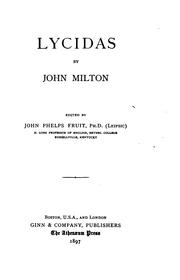
"Lycidas" is a poem by John Milton, written in 1637 as a pastoral elegy. It first appeared in a 1638 collection of elegies, Justa Edouardo King Naufrago, dedicated to the memory of Edward King, a friend of Milton at Cambridge who drowned when his ship sank in the Irish Sea off the coast of Wales in August 1637. The poem is 193 lines in length and is irregularly rhymed. Many of the other poems in the compilation are in Greek and Latin, but "Lycidas" is one of the poems written in English. Milton republished the poem in 1645.
History of the name Lycidas
Herodotus in his Book IX (written in the 5th century BC) mentions an Athenian councilor in Salamis, "a man named Lycidas" (Λυκίδας), who proposed to his fellow citizens that they submit to a compromise offered by their enemy, Persian King Xerxes I, with whom they were at war. Suspected of collusion with the enemy for suggesting the compromise, Lycidas was stoned to death by "those in the council and those outside, [who] were so enraged.... [W]ith all the uproar in Salamis over Lycidas, the Athenian women soon found out what had happened; whereupon, without a word from the men, they got together, and, each one urging on her neighbor and taking her along with the crowd, flocked to Lycidas' house and stoned his wife and children."
The name later occurs in Theocritus's Idylls, where Lycidas is most prominently a poet-goatherd encountered on the trip of "Idyll vii." The name appears several times in Virgil and is a typically Doric shepherd's name, appropriate for the pastoral mode. A Lycidas appears in Ovid's Metamorphoses as a centaur.
Lycidas also occurs in Lucan's Pharsalia, where in iii.636 a sailor named Lycidas is ripped by an iron hook from the deck of a ship.
"Lycidas" as pastoral elegy
By naming Edward King "Lycidas," Milton follows "the tradition of memorializing a loved one through Pastoral poetry, a practice that may be traced from ancient Greek Sicily through Roman culture and into the Christian Middle Ages and early Renaissance." Milton describes King as "selfless," even though he was of the clergy – a statement both bold and, at the time, controversial among lay people: "Through allegory, the speaker accuses God of unjustly punishing the young, selfless King, whose premature death ended a career that would have unfolded in stark contrast to the majority of the ministers and bishops of the Church of England, whom the speaker condemns as depraved, materialistic, and selfish."
Authors and poets in the Renaissance used the pastoral mode in order to represent an ideal of life in a simple, rural landscape. Literary critics have emphasized the artificial character of pastoral nature: "The pastoral was in its very origin a sort of toy, literature of make-believe." Milton himself "recognized the pastoral as one of the natural modes of literary expression," employing it throughout "Lycidas" in order to achieve a strange juxtaposition between death and the remembrance of a loved one.
The poem itself begins with a pastoral image of laurels and myrtles, "symbols of poetic fame; as their berries are not yet ripe, the poet is not yet ready to take up his pen". However, the speaker is so filled with sorrow for the death of Lycidas that he finally begins to write an elegy. "Yet the untimely death of young Lycidas requires equally untimely verses from the poet. Invoking the muses of poetic inspiration, the shepherd-poet takes up the task, partly, he says, in hope that his own death will not go unlamented." The speaker continues by recalling the life of the young shepherds together "in the 'pastures' of Cambridge." Milton uses the pastoral idiom to allegorize experiences he and King shared as fellow students at Christ's College, Cambridge. The university is represented as the "self-same hill" upon which the speaker and Lycidas were "nurst"; their studies are likened to the shepherds' work of "dr[iving] a field" and "Batt’ning… flocks"; classmates are "Rough satyrs" and "fauns with clov’n heel" and the dramatic and comedic pastimes they pursued are "Rural ditties… / Temper’ed to th' oaten flute"; a Cambridge professor is "old Damoetas [who] lov’d to hear our song". The poet then notes the "'heavy change' suffered by nature now that Lycidas is gone—a ‘pathetic fallacy’ in which the willows, hazel groves, woods, and caves lament Lycidas's death." In the next section of the poem, "The shepherd-poet reflects… that thoughts of how Lycidas might have been saved are futile… turning from lamenting Lycidas’s death to lamenting the futility of all human labor." This section is followed by an interruption in the swain's monologue by the voice of Phoebus, "the sun-god, an image drawn out of the mythology of classical Roman poetry, [who] replies that fame is not mortal but eternal, witnessed by Jove (God) himself on judgment day." At the end of the poem, King/Lycidas appears as a resurrected figure, being delivered, through the resurrecting power of Christ, by the waters that lead to his death: "Burnished by the sun's rays at dawn, King resplendently ascends heavenward to his eternal reward."
Although on its surface "Lycidas" reads like a straightforward pastoral elegy, a closer reading reveals its complexity. "Lycidas" has been called "'probably the most perfect piece of pure literature in existence…’ [employing] patterns of structure, prosody, and imagery to maintain a dynamic coherence. The syntax of the poem is full of 'impertinent auxiliary assertions' that contribute valuably to the experience of the poem." The piece itself is remarkably dynamic, enabling many different styles and patterns to overlap, so that "the loose ends of any one pattern disappear into the interweavings of the others."
"Lycidas" also has its detractors, including 18th-century literary critic and polymath Samuel Johnson, who infamously called the pastoral form "easy, vulgar, and therefore disgusting," and said of Milton's elegy:
以上文字摘自英文维基百科「Lycidas」(有删节,去掉了参考文献等尾部小节),按 CC BY-SA 4.0 使用,作者为维基百科的各位编者。
资料卡
- 原作语言
- 英语
- 首次出版
- 1638 年
- 作品形式
- 诗作
- 体裁
- 诗歌
资料卡来自 Wikidata Q1645997(CC0),众包数据,个别字段可能不全。