书单
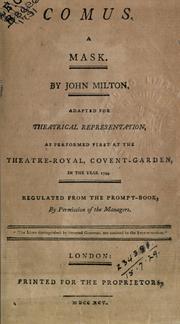
酒神之假面舞会 (1637)
百科
这个词条暂时没有中文维基百科条目,下面是英文维基百科的内容(英文原文):
Comus (A Masque Presented at Ludlow Castle, 1634) is a masque in honour of chastity written by John Milton. It was first presented on Michaelmas 1634 before John Egerton, 1st Earl of Bridgewater, at Ludlow Castle in celebration of the Earl's new post as Lord President of Wales.
The masque is known colloquially as Comus, but the full title in its first publication is A Maske presented at Ludlow Castle, 1634: on Michaelmasse night, before the Right Honorable, John Earle of Bridgewater, Viscount Brackly, Lord President of Wales, and one of His Majesties most honorable privie counsell. It was performed for the Earl of Bridgewater on 29 September 1634. The performance also featured Egerton's two sons as the Elder Brother and Second Brother, and his daughter Alice as the Lady.
Comus was printed anonymously in 1637 in a quarto issued by bookseller Humphrey Robinson. Milton included the work in his Poems of 1645 and 1673. His text was adapted for a highly successful masque by musician Thomas Arne in 1738, which ran for more than 70 years in London. There were also later settings of episodes from Milton's masque by George Frideric Handel and Hugh Wood.
Plot
The plot concerns two brothers and their sister, simply called "the Lady", lost in a journey through the woods. The Lady becomes fatigued, and the brothers wander off in search of sustenance.
While alone, she encounters the debauched Comus, a character inspired by the god of revelry (Ancient Greek: Κῶμος, Kōmos), who is disguised as a villager and claims he will lead her to her brothers. Deceived by his amiable countenance, the Lady follows him, only to be captured, brought to his pleasure palace and victimised by his necromancy. Seated on an enchanted chair, with "gums of glutinous heat", she is immobilised, and Comus accosts her while with one hand he holds a necromancer's wand and with the other he offers a vessel with a drink that would overpower her. Comus urges the Lady to "be not coy" and drink from his magical cup (representing sexual pleasure and intemperance), but she repeatedly refuses, arguing for the virtuousness of temperance and chastity. Within view at his palace is an array of cuisine intended to arouse the Lady's appetites and desires. Despite being restrained against her will, she continues to exercise right reason (recta ratio) in her disputation with Comus, thereby manifesting her freedom of mind. Whereas the would-be seducer argues appetites and desires issuing from one's nature are "natural" and therefore licit, the Lady contends that only rational self-control is enlightened and virtuous. To be self-indulgent and intemperate, she adds, is to forfeit one's higher nature and to yield to baser impulses. In this debate the Lady and Comus signify, respectively, soul and body, ratio and libido, sublimation and sensuality, virtue and vice, moral rectitude and immoral depravity. In line with the theme of the journey that distinguishes Comus, the Lady has been deceived by the guile of a treacherous character, temporarily waylaid, and besieged by sophistry that is disguised as wisdom.
Meanwhile, her brothers, searching for her, come across the Attendant Spirit, an angelic figure sent to aid them, who takes the form of a shepherd and tells them how to defeat Comus. As the Lady continues to assert her freedom of mind and to exercise her free will by resistance and even defiance, she is rescued by the Attendant Spirit along with her brothers, who chase off Comus. The Lady remains magically bound to her chair. With a song, the Spirit conjures the water nymph Sabrina who frees the Lady on account of her steadfast virtue. She and her brothers are reunited with their parents in a triumphal celebration, which signifies the heavenly bliss awaiting the wayfaring soul that prevails over trials and travails, whether these are the threats posed by overt evil or the blandishments of temptation.
Comus and the masque genre
Masques were a favourite court celebration dating from at least the reign of Elizabeth I, but became very popular under the Stuarts. The main parts were often played by courtiers, nobles and sometimes even the royals. In fact, Caroline masques (of which Comus is an example) frequently featured the King Charles I and Queen (Henrietta Maria), as they were far more interested in becoming involved than King James and his queen Anne had been.
This masque was not performed at the court, however, but at the home of Lord Bridgewater, Ludlow Castle. It was commissioned to celebrate the appointment of Lord Bridgewater to the post of Lord President of Wales. References to this are clearly evident in the text, such as the Attendant Spirit's reference to the children's father's "new-entrusted sceptre" in his opening speech.
Bridgewater's own children were the principal actors in this masque, including his 15 year-old daughter, Alice Egerton. The Puritan Milton's use of the genre, however, may be seen as an attempt for him to "reclaim" masque, which was associated with the perceived debauchery of the royal court, for godly or virtuous purposes. Rather than praising an aristocrat, the famous concluding lines of the masque, recited by the Attendant Spirit, urge
Comus was influenced by a prior masque, Aurelian Townshend's Tempe Restored, which had been staged at the Palace of Whitehall in London in February 1632. Both Henry Lawes and Alice Egerton, the Earl's daughter who played the Lady, had performed in Townshend's masque.
以上文字摘自英文维基百科「Comus (Milton)」(有删节,去掉了参考文献等尾部小节),按 CC BY-SA 4.0 使用,作者为维基百科的各位编者。
资料卡
- 原题
- A Mask presented at Ludlow Castle, 1634: on Michelmas night, before the Rt Hon. Iohn Earl of Bridgewater, Viscount Brackly, Lord President of Wales, and one of His Maiesties most honorable privie councill
- 原作语言
- 英语
- 首次出版
- 1637 年
资料卡来自 Wikidata Q5157862(CC0),众包数据,个别字段可能不全。
改编作品
舞台剧 / 歌剧 / 芭蕾1
名单来自 Wikidata(CC0):只列条目里写明「改编自 / 取材于」这本书的作品,不按名字猜;众包数据,可能不全。
更多资料与书评
在哪读
约翰·弥尔顿 的其他作品
作者页 ›相似的书