书单
百科
这个词条暂时没有中文维基百科条目,下面是英文维基百科的内容(英文原文):
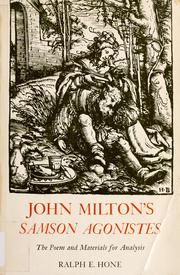
Samson Agonistes (from Greek Σαμσών ἀγωνιστής, "Samson the struggler, or champion,") is a tragic closet drama by John Milton. It appeared with the publication of Milton's Paradise Regained in 1671, as the title page of that volume states: "Paradise Regained / A Poem / In IV Books / To Which Is Added / Samson Agonistes". It is generally thought that Samson Agonistes was begun around the same time as Paradise Regained but was completed after the larger work, possibly very close to the date of publishing, but there is no certainty.
Background
Milton began plotting various subjects for tragedies in a notebook created in the 1640s. Many of the ideas dealt with the topic of Samson, and he gave them titles such as Samson pursophorus or Hybristes ("Samson the Firebrand, or Samson the Violent"), Samson marriing or in Ramath Lechi, and Dagonalia (the unholy rites at which Samson performed his vindication of God). The title he chose emphasises Samson as a warrior or an athlete, and the play was included with Paradise Regained and printed on 29 May 1671 by John Starkey. It is uncertain as to when the work was composed, which leaves the possibility that it was an early work that was filled with Milton's ideas about the English Civil War or it was a later work that incorporates his despair over the Restoration. Evidence for the early dating is based on his early works and his belief in revolution whereas evidence for a later dating connects the play with his later works, such as Paradise Lost, and comments reflecting on the fall of the Commonwealth. In 1671, the work was printed with a new title page and prefaced his work with a discussion on Greek tragedy and Aristotle's Poetics.
On the title page, Milton wrote that the piece was a "Dramatic Poem" rather than a drama. He did not wish for it to be performed on stage, but thought that the text could still influence people. He hoped that by giving Samson attributes of other Biblical figures, including Job or the Psalmist, he could create a complex hero who would embody and help resolve theological issues.
In writing the poem and choosing the character of Samson as his hero, Milton was also illustrating his own blindness, which afflicted him in his later life.
Play
Samson Agonistes draws on the story of Samson from the Old Testament, Judges 13–16; in fact it is a dramatisation of the story starting at Judges 16:23. The drama starts in medias res. Samson has been captured by the Philistines, had his hair, the container of his strength, cut off and his eyes cut out. Samson is "Blind among enemies, O worse than chains" (line 66).
Near the beginning of the play, Samson humbles himself before God by admitting that his power is not his own: "God, when he gave me strength, to show withal / How slight the gift was, hung it in my hair" (lines 58–9).
The Chorus discusses Samson's background and describes his various military accomplishments:
Ran on embattled armies clad in iron,
And, weaponless himself,
Made arms ridiculous, useless the forgery
Of brazen shield and spear, the hammered cuirass,
Chalybean-tempered steel, and frock of mail
Adamantean proof;
Then with what trivial weapon came to hand,
The jaw of a dead ass, his sword of bone,
A thousand foreskins fell
(lines 129–134, 142–4)
Although he is great, the Chorus points out that, through his blindness (actual and metaphorically), he is a prisoner:
Thou art become (O worst imprisonment!)
The Dungeon of thy self; thy soul
(Which men enjoying sight oft without cause complain)
Imprisoned now indeed,
In real darkness of the body dwells,
Shut up from outward light
To incorporate with gloomy night
For inward light alas
Puts forth no visual beam
(lines 155–163)
Samson reveals how he lost his power because of his desire for Delilah, and, through this act, betrayed God:
I yielded, and unlocked her all my heart,
Who with a grain of manhood well resolved
Might easily have shook off all her snares:
But foul effeminancy held me yoked
Her bond-slave. O indignity, O blot
To honor and religion! Servile mind
Rewarded well with servile punishment!
(lines 407–413)
However, his state is more than just his own, and it represents a metaphor for the suffering of God's chosen people when Samson says:
Or to th' unjust tribunals, under change of times,
And condemnation of the ingrateful multitude.
If these they scape, perhaps in poverty
With sickness and disease thou bow'st them down,
(lines 695–698)
After Samson rejects Dalila's pleas, she asks for Samson to "let me approach at least, and touch thy hand" (line 951), and Samson responds, "Not for thy life, lest fierce remembrance wake / My sudden rage to tear thee joint by joint" (lines 952–3). He shows Dalila how not to upset him: "At distance I forgive thee, go with that" (line 954). The Chorus, shortly after, complains about the nature of women and how deceptive they are:
Whate'er it be, to wisest men and best
Seeming at first all heavenly under virgin veil,
Soft, modest, meek, demure,
Once joined, the contrary she proves, a thorn
Intestine, far within defensive arms
A cleaving mischief, in his way to virtue
Adverse and turbulent, or by her charms
Draws him awry enslaved
With dotage, and his sense depraved
To folly and shameful deeds which ruin ends.
(lines 1034–1043)
Harapha points out that Samson is
... no worthy match
For valor to assail, nor by the sword
Of noble warrior ...
But by the barber’s razor best subdued
(lines 1164-7)
But he does describe Samson's past accomplishments when he says "thou art famed / To have wrought such wonders with an ass’s jaw" (lines 1094–5).
The Chorus discusses how God grants individuals with the power to free his people from their bonds, especially through violent means:
He all their ammunition
And feats of war defeats
With plain heroic magnitude of mind
And celestial vigor armed;
Their armouries and magazines contemns,
Renders them useless, while
With winged expedition
Swift as the lightning glance he executes
His errand on the wicked, who surprised
Lose their defence, distracted and amazed.
(lines 1277–86)
以上文字摘自英文维基百科「Samson Agonistes」(有删节,去掉了参考文献等尾部小节),按 CC BY-SA 4.0 使用,作者为维基百科的各位编者。
资料卡
- 原题
- Samson Agonistes
- 原作语言
- 英语
- 首次出版
- 1671 年
- 体裁
- 叙事诗、戏剧
资料卡来自 Wikidata Q2184939(CC0),众包数据,个别字段可能不全。