书单
百科
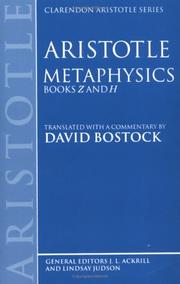
《形而上学》(希腊语:τὰ μετὰ τὰ φυσικά;拉丁语:Metaphysica)是希腊哲学家亚里士多德的主要著作之一,他在其中发展了他有时称为智慧的法则,该法则有时称作第一哲学,有称作神学。 它是西方哲学分支即形而上学的首批主要著作之一。
它是处理抽象主题的各种文本的汇编,特别是存在、各种因果关系、形式和物质、数学对象的存在和宇宙。
以上文字摘自维基百科「形而上学 (亚里士多德)」(去掉了参考文献等尾部小节),按 CC BY-SA 4.0 使用,作者为维基百科的各位编者。
中文维基百科的条目比较短,下面附上英文维基百科的内容(英文原文):
Metaphysics (Greek: τὰ μετὰ τὰ φυσικά, "those after the physics"; Latin: Metaphysica) is one of the principal works of Aristotle, in which he develops the doctrine that he calls First Philosophy. The work is a compilation of various texts treating abstract subjects, notably substance theory, different kinds of causation, form and matter, the existence of mathematical objects and the cosmos, which together constitute much of the branch of philosophy later known as metaphysics.
Date, style and composition
Many of Aristotle's works are extremely compressed, and many scholars believe that in their current form, they are likely lecture notes. Subsequent to the arrangement of Aristotle's works by Andronicus of Rhodes in the first century BC, a number of his treatises were referred to as the writings "after ("meta") the Physics", the origin of the current title for the collection Metaphysics. Some scholars, such as Eduard Zeller, Werner Jaeger, and Jonathan Barnes, have interpreted the expression “meta” to imply that the subject of the work goes “beyond” that of Aristotle’s Physics or that it is metatheoretical in relation to the Physics.. But other scholars, including Alexander Grant, W. D. Ross, and contemporary commentators such as those cited in modern bibliographies, believe that “meta” referred simply to the work’s place in the canonical arrangement of Aristotle’s writings, which is at least as old as Andronicus of Rhodes or even Hermippus of Smyrna. In other surviving works of Aristotle, the metaphysical treatises are referred to as "the [writings] concerning first philosophy"; which was the term Aristotle used for metaphysics.
It is notoriously difficult to specify the date at which Aristotle wrote these treatises as a whole or even individually, especially because the Metaphysics is, in Jonathan Barnes' words, "a farrago, a hotch-potch", and more generally because of the difficulty of dating any of Aristotle's writings. The order in which the books were written is not known; their arrangement is due to later editors. In the manuscripts, books are referred to by Greek letters. For many scholars, it is customary to refer to the books by their letter names. Book 1 is called Alpha (Α); 2, little alpha (α); 3, Beta (Β); 4, Gamma (Γ); 5, Delta (Δ); 6, Epsilon (Ε); 7, Zeta (Ζ); 8, Eta (Η); 9, Theta (Θ); 10, Iota (Ι); 11, Kappa (Κ); 12, Lambda (Λ); 13, Mu (Μ); 14, Nu (Ν).
Outline
Books I–VI: Alpha, little Alpha, Beta, Gamma, Delta and Epsilon
Book I or Alpha begins by discussing the nature of knowledge and compares knowledge gained from the senses and from memory, arguing that knowledge is acquired from memory through experience. It then defines "wisdom" (sophia) as a knowledge of the first principles (arche) or causes of things. Because those who are wise understand the first principles and causes, they know the why of things, unlike those who only know that things are a certain way based on their memory and sensations. The wise are able to teach because they know the why of things, and so they are better fitted to command, rather than to obey. He then surveys the first principles and causes of previous philosophers, starting with the material monists of the Ionian school and continuing up until Plato.
Book II or "little alpha": Book II addresses a possible objection to the account of how we understand first principles and thus acquire wisdom, that attempting to discover the first principle would lead to an infinite series of causes. It argues in response that the idea of an infinite causal series is absurd, and argues that only things that are created or destroyed require a cause, and that thus there must be a primary cause that is eternal, an idea he develops later in Book Lambda.
Book III or Beta lists the main problems or puzzles (aporia) of philosophy.
以上文字摘自英文维基百科「Metaphysics (Aristotle)」(有删节,去掉了参考文献等尾部小节),按 CC BY-SA 4.0 使用,作者为维基百科的各位编者。
资料卡
- 原题
- Τὰ μετὰ τὰ φυσικά
- 原作语言
- 古希腊语
- 体裁
- 专论
- 主题
- 形而上学
资料卡来自 Wikidata Q661655(CC0),众包数据,个别字段可能不全。