 书单
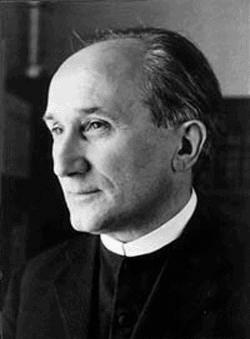
郭蒂尼
- 生卒
- 1885 – 1968
- 国籍
- 德国
- 外文名
- Romano Guardini
照片:作者不详,公有领域,来自维基共享资源「Romano Guardini um 1920.JPG」(经缩小)。
生平与创作
这个词条暂时没有中文维基百科条目,下面是英文维基百科的内容(英文原文):
Romano Guardini (17 February 1885, Verona, Italy – 1 October 1968, Munich, Germany) was an Italian, naturalized German Catholic priest, philosopher and theologian.
Life
Romano Michele Antonio Maria Guardini was born in Verona in 1885 and was baptized in the Church of San Nicolò all'Arena. His father, Romano Tullo (1857–1919), was a poultry wholesaler. Guardini had three younger brothers. The family moved to Mainz when he was one year old, and he lived in Germany for the rest of his life. He attended the Rabanus-Maurus-Gymnasium. Guardini wrote that as a young man he was “always anxious and very scrupulous.”
Fluent in Italian and German, he also studied Latin, Greek, French, and English. After studying chemistry at the University of Tübingen for two semesters, and economics at the Ludwig-Maximilians-Universität München and the Friedrich Wilhelm University of Berlin for three semesters, he decided to become a priest. He studied theology at the University of Freiburg and the University of Tübingen. Impressed by the monastic spirituality of the monks of Beuron Archabbey, he became a Benedictine oblate, taking the name Odilio. Guardini was ordained a diocesan priest in Mainz by Georg Heinrich Kirstein in 1910.
He became a German citizen in 1911 so that he could teach theology in Germany, a job paid by the government. He briefly worked in a pastoral position at St. Christoph's Church in Mainz before returning to Freiburg to work on his doctorate in Theology under Engelbert Krebs. He received his doctorate in 1915 for a dissertation on Bonaventure. He completed his "Habilitation" in Dogmatic Theology at the University of Bonn in 1922, again with a dissertation on Bonaventure. Throughout this period, he also worked as a parish priest at St. Ignatius, St. Emmeran's, and St. Peter's and served as chaplain to the Catholic youth movement. During World War I he served as a hospital orderly.
In 1923, he was appointed to a chair in Philosophy of Religion at the Friedrich Wilhelm University of Berlin. In the 1935 essay "Der Heiland" (The Saviour), he criticized Nazi mythologizing of the person of Jesus and emphasized the Jewishness of Jesus. The Nazis forced him to resign from his Berlin position in 1939. From 1943 to 1945, he retired to Mooshausen, where his friend Josef Weiger had been a parish priest since 1917.
In 1945, Guardini was appointed professor in the Faculty of Philosophy at the University of Tübingen and resumed lecturing on the Philosophy of Religion. In 1948, he became professor at the Ludwig-Maximilians-Universität München, where he remained until retiring for health reasons in 1962. That same year, he received the Erasmus Prize, an annual prize awarded by the board of the Praemium Erasmianum Foundation to individuals or institutions that have made exceptional contributions to culture, society, or social science in Europe.
Pope Paul VI offered to make Guardini a cardinal in 1965, but he declined.
Guardini died in Munich on 1 October 1968. He was buried in the priests’ cemetery of the Oratory of St. Philip Neri in the city. His estate was left to the Catholic Academy in Bavaria that he had co-founded.
Veneration
In December 2017, the Archdiocese of Munich and Freising opened the beatification process for Guardini, thus designating him a Servant of God.
Reputation and influence
Guardini's books were often powerful studies of traditional themes in the light of present-day challenges or examinations of current problems as approached from the Christian, and especially Catholic, tradition. He was able to enter into the worldview of those such as Socrates, Plato, Augustine, Dante, Pascal, Kierkegaard, Dostoevsky and Nietzsche, and make sense of them for modern readers.
His first major work, Vom Geist der Liturgie (The Spirit of the Liturgy), published during the First World War, was a major influence on the Liturgical Movement in Germany and, by extension, on the liturgical reforms of the Second Vatican Council. He is generally regarded as the father of the liturgical movement in Germany, and in his "Open Letter" of April 1964 to Mgr. Johannes Wagner, the organizer of the Third German Liturgical Congress in Mainz, he "raises important questions regarding the nature of the liturgical act in the wake of individualism, asking whether it is possible for twentieth-century Christians really to engage in worship. Is it possible to 'relearn a forgotten way of doing things and recapture lost attitudes', so as to enter into the liturgical experience?' It was his glad hope that after the call by the Second Vatican Council for liturgical reform, the Catholic Church might shift its focus from the merely ceremonial, important though that was, to a broader idea of true liturgical action—action that "embraced not only a spiritual inwardness, but the whole man, body as well as spirit." He himself gave an example of his meaning: A parish priest of the late 19th century once said (according to Guardini's illustration), "We must organize the procession better; we must see to it that the praying and singing is done better." For Guardini, the parish priest had missed the point of what true liturgical action is. He should instead have asked, "How can the act of walking become a religious act, a retinue for the Lord progressing through his land, so that an 'epiphany' may take place?"
以上文字摘自英文维基百科「Romano Guardini」(有删节,去掉了参考文献等尾部小节),按 CC BY-SA 4.0 使用,作者为维基百科的各位编者。
资料卡
- 母语名
- Romano Guardini
- 出生
- 1885 年 2 月 17 日
- 出生地
- 维罗纳
- 逝世
- 1968 年 10 月 1 日
- 逝世地
- 慕尼黑
- 职业
- 天主教神父、作家、神学家、大学教师、哲学家、天主教神学家
- 使用语言
- 德语、意大利语
- 就读学校
- 蒂宾根大学、波恩大学、弗赖堡大学、Rabanus-Maurus-Gymnasium
- 所属团体
- 巴伐利亚造型艺术学院
- 获奖
- 巴伐利亚荣誉勋章(1958)、伊拉斯谟奖(1962)、德国书商和平奖(1952);另有 6 项只有外文名
资料卡来自 Wikidata Q44872(CC0),众包数据,个别字段可能不全。
本站收录的作品(1)
作品年表(2 本)
本站书库里署名郭蒂尼的书(Open Library 上至少 10 人加过书架的才收),按首版年份排(有本站书页的用 Wikidata 记的首版年,其余用 Open Library 的);年份偶尔记成后来的版本或译本,以原书为准。全部作品见 Open Library。
- 1937Herr书架 11
- 1956The End of the Modern World书架 12