 书单
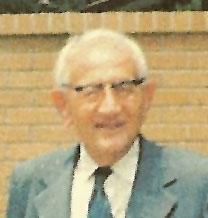
乔治·波利亚
- 生卒
- 1887 – 1985
- 国籍
- 匈牙利、美国
- 外文名
- George Pólya
照片:Thane Plambeck from Palo Alto, California,CC BY 2.0,来自维基共享资源「George Pólya ca 1973.jpg」(经缩小)。
生平与创作
乔治·波利亚(英语:George Pólya,/ˈpoʊljə/,常缩写作G. Pólya;匈牙利语:Pólya György, 发音:[ˈpoːjɒ ˈɟørɟ],1887年12月13日—1985年9月7日),匈牙利原语名波尧·哲尔吉(匈牙利语:Pólya György,匈牙利语发音:[ˈpoːjɒ ˈɟørɟ]),是一名匈牙利裔美国数学家和数学教育家。波利亚生于匈牙利布达佩斯,1940年移居美国,历任布朗大学和斯坦福大学教授。他在大量的数学范畴工作,包括级数、数论、组合数学和机率;他在1937年提出的波利亚计数定理,是组合数学的重要工具。同时,他长期从事数学教育,对数学思维的普遍规律有深入的研究。
著作
有关解题的著作:
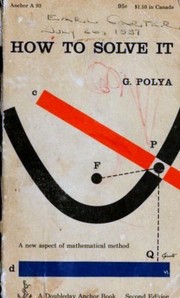
《怎样解题》(How to Solve It)
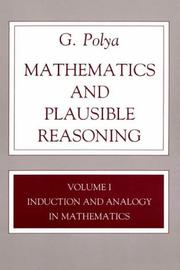
《数学与猜想》(Mathematics and plausible reasoning)
《数学发现》(Mathematical discovery)
其他:
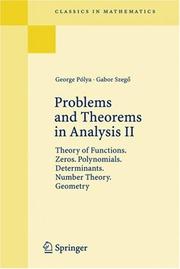
《数学分析中的问题和定理》(Problems and theorems in analysis)
《复变函数》(Complex variables,与Gordon Latta合写)
以上文字摘自维基百科「喬治·波利亞」(去掉了参考文献等尾部小节),按 CC BY-SA 4.0 使用,作者为维基百科的各位编者。
中文维基百科的条目比较短,下面附上英文维基百科的内容(英文原文):
George Pólya (Hungarian: Pólya György [ˈpoːjɒ ˈɟørɟ]; December 13, 1887 – September 7, 1985) was a Hungarian-American mathematician. He was a professor of mathematics from 1914 to 1940 at ETH Zürich and from 1940 to 1953 at Stanford University. He made fundamental contributions to combinatorics, number theory, complex analysis, numerical analysis and probability theory. He is also noted for his work in heuristics and mathematics education. He has been described as one of The Martians, an informal category of Hungarian-American scientists that also included one of his most famous students, John von Neumann.
Life and works
Pólya was born in Budapest, Austria-Hungary, to Anna Deutsch and Jakab Pólya, Hungarian Jews who had converted to Christianity in 1886. Although his parents were religious and he was baptized into the Catholic Church upon birth, George eventually grew up to be an agnostic. He received a PhD under Lipót Fejér in 1912, at Eötvös Loránd University. He was a professor of mathematics from 1914 to 1940 at ETH Zürich in Switzerland and from 1940 to 1953 at Stanford University. He remained a professor emeritus at Stanford for the rest of his career, working on a range of mathematical topics, including series, number theory, mathematical analysis, geometry, algebra, combinatorics, and probability. He was invited to speak at the International Congress of Mathematicians at Bologna in 1928, at Oslo in 1936 and at Cambridge, Massachusetts, in 1950. He continued lecturing part-time and publishing books into his nineties, decades after his official retirement in 1953.
On September 7, 1985, Pólya died at age 97 in Palo Alto, California, due to complications of a stroke he suffered during that summer. He was survived by his wife Stella, after 67 years of marriage.
Heuristics
Early in his career, Pólya wrote with Gábor Szegő two influential problem books, Problems and Theorems in Analysis (I: Series, Integral Calculus, Theory of Functions and II: Theory of Functions, Zeros, Polynomials, Determinants, Number Theory, Geometry). Later in his career, he spent considerable effort to identify systematic methods of problem solving to foster discovery and invention for students, teachers, and researchers. He wrote five books on the subject: How to Solve It, Mathematics and Plausible Reasoning (Volume I: Induction and Analogy in Mathematics, and Volume II: Patterns of Plausible Inference), and Mathematical Discovery: On Understanding, Learning, and Teaching Problem Solving (volumes 1 and 2).
In How to Solve It, Pólya provides general heuristics for solving a gamut of mathematical and non-mathematical problems. The book includes advice for teachers and a mini-encyclopedia of heuristic terms. It was translated into several languages and has sold over a million copies. The book is still used in mathematical education. Douglas Lenat's Automated Mathematician and Eurisko artificial intelligence programs were inspired by Pólya's work.
In addition to his works directly addressing problem solving, Pólya authored another short book called Mathematical Methods in Science edited by Leon Bowden, initially a 1963 work supported by the National Science Foundation, later revised in 1977. As Pólya notes in the preface, Bowden carefully followed a tape recording of a course that Pólya taught several times at Stanford, in order to put the book together. Pólya notes in the preface that "the following pages will be useful, yet they should not be regarded as a finished expression."
以上文字摘自英文维基百科「George Pólya」(有删节,去掉了参考文献等尾部小节),按 CC BY-SA 4.0 使用,作者为维基百科的各位编者。
资料卡
- 母语名
- Pólya György
- 出生
- 1887 年 12 月 13 日
- 出生地
- 布达佩斯
- 逝世
- 1985 年 9 月 8 日
- 逝世地
- 帕洛阿尔托
- 职业
- 数学家、大学教师
- 使用语言
- 英语、匈牙利语、意大利语、法语 等 6 项
- 就读学校
- 罗兰大学(1905)、维也纳大学(1910)、Berzsenyi Dániel Secondary School(1894)、哥廷根大学(1912)
- 领域
- 数学分析、组合数学、数学、数论、数值分析 等 8 项
- 所属团体
- 美国国家科学院、匈牙利科学院、美国文理科学院
- 代表作
- 怎样解题(1945)、波利亚猜想、富特-波利亚定理、波利亚-塞格不等式、Laguerre–Pólya class、波壶模型模型、波利亚计数定理、Beta negative binomial distribution
资料卡来自 Wikidata Q296259(CC0),众包数据,个别字段可能不全。
本站收录的作品(3)
作品年表(4 本)
本站书库里署名乔治·波利亚的书(Open Library 上至少 10 人加过书架的才收),按首版年份排(有本站书页的用 Wikidata 记的首版年,其余用 Open Library 的);年份偶尔记成后来的版本或译本,以原书为准。全部作品见 Open Library。
- 1925Problems and theorems in analysis书架 11
- 1945怎样解题How to solve it书架 367
- 1954Mathematics and plausible reasoning书架 56
- 1962Mathematical discovery书架 15