 书单
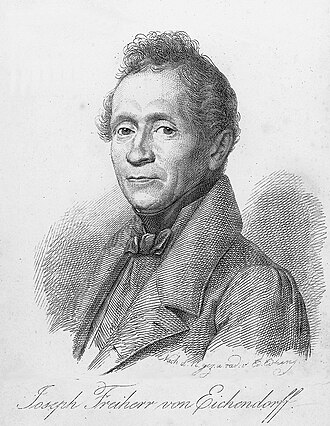
约瑟夫·弗赖赫尔·冯·艾兴多尔夫
- 生卒
- 1788 – 1857
- 国籍
- 普鲁士王国
- 外文名
- Joseph von Eichendorff
照片:E. Eichens,公有领域,来自维基共享资源「Eichendorff Stahlstich von Eichens.jpg」(经缩小)。
生平与创作
约瑟夫·冯·艾兴多夫男爵(德语:Joseph Freiherr von Eichendorff,1788年3月10日—1857年11月26日),德国诗人,小说家。约瑟夫被视为德国最重要的浪漫主义作家,他的作品从诞生之初到现代在德国都很流行。
生平
(1788-03-10)1788年3月10日,约瑟夫·冯·艾兴多夫在普鲁士王国上西里西亚拉齐布日出生。他的父亲是阿道夫·冯·艾兴多夫男爵(Adolf Freiherr von Eichendorff ),一名普鲁士军官。他的母亲是卡罗利妮(Karoline,出生名Freiin von Kloche),来自天主教会贵族家庭。自1805年起,约瑟夫分别在哈雷和海德堡学习法律。1808年,他走遍欧洲,访问巴黎与维也纳。1810年,他回到家乡帮助父亲经营家族地产。同年,他在柏林结识了海因里希·冯·克莱斯特与约翰·戈特利布·费希特等。1813年到1815年,他参加拿破仑战争,在吕措陆战队中当志愿军。
从1816年起,约瑟夫在普鲁士担任行政工作。起初他在弗罗茨瓦夫的司法机关里工作。1821年,他在格但斯克担任学校检察员,1824年在柯尼斯堡担任此职。1831年,他举家迁往柏林,在那里为几个部门工作后,于1844年退休。1857年11月26日(1857-11-26),约瑟夫在上西里西亚尼斯逝世。
以上文字摘自维基百科「约瑟夫·冯·艾兴多夫」(去掉了参考文献等尾部小节),按 CC BY-SA 4.0 使用,作者为维基百科的各位编者。
中文维基百科的条目比较短,下面附上英文维基百科的内容(英文原文):
Joseph Karl Benedikt Freiherr von Eichendorff (German: [fɔn ˈaɪçn̩dɔʁf]; 10 March 1788 – 26 November 1857) was a German poet, novelist, playwright, literary critic, translator, and anthologist. Eichendorff was one of the major writers and critics of Romanticism. Ever since their publication and up to the present day, some of his works have been very popular in German-speaking Europe.
Eichendorff first became famous for his 1826 novella Aus dem Leben eines Taugenichts (freely translated: Memoirs of a Good-for-Nothing) and his poems. The Memoirs of a Good-for-Nothing is a typical Romantic novella whose main themes are wanderlust and love. The protagonist, the son of a miller, rejects his father's trade and becomes a gardener at a Viennese palace where he subsequently falls in love with the local duke's daughter. As, with his lowly status, she is unattainable for him, he escapes to Italy – only to return and learn that she is the duke's adopted daughter, and thus within his social reach. With its combination of dream world and realism, Memoirs of a Good-for-Nothing is considered to be a high point of Romantic fiction. One critic stated that Eichendorff's Good-for-Nothing is the "personification of love of nature and an obsession with hiking." Thomas Mann called Eichendorff's Good-for-Nothing a combination of "the purity of the folk song and the fairy tale."
Many of Eichendorff's poems were first published as integral parts of his novellas and stories, where they are often performed in song by one of the protagonists. The novella Good-for-Nothing alone contains 54 poems.
Biography
Origin and early youth
Eichendorff, a descendant of an old noble family, was born in 1788 at Lubowitz Castle in Lubowitz near Ratibor in Upper Silesia, at that time part of the Kingdom of Prussia (now Łubowice near Racibórz, Poland). His parents were the Prussian officer Adolf Freiherr von Eichendorff (1756–1818) and his wife, Karoline née Freiin von Kloche (1766–1822), who came from an aristocratic Roman Catholic family. Eichendorff sold the family estates in Deutsch-Krawarn, Kauthen, and Wrbkau and acquired Lubowitz Castle from his mother-in-law. The castle's Rococo reconstruction, which was begun by her, was very expensive and almost bankrupted the family. Young Joseph was close to his older brother Wilhelm (1786–1849). From 1793 to 1801, they were home-schooled by tutor Bernhard Heinke. Joseph began writing diaries as early as 1798, witnesses to his budding literary career. The diaries present many insights into the development of the young writer, ranging from simple statements about the weather to notes about finances to early poems. At a young age, Eichendorff was already well aware of his parents' financial straits. On 19 June 1801, the thirteen-year old noted in his diary: "Father travelled to Breslau, on the run from his creditors," adding on 24 June, "mom become terribly faint." With his brother Wilhelm, Joseph attended the Catholic Matthias Gymnasium in Breslau (1801–1804). While previously preferring chapbooks, he was now introduced to the poetry of Matthias Claudius and Voltaire's La Henriade, an epic poem about the last part of the wars of religion and Henry IV of France in ten songs. In 1804 his sister Luise Antonie Nepomucene Johanna was born (died 1883), who was to become a friend of Austrian writer Adalbert Stifter. After their final exams, both brothers attended lectures at the University of Breslau and the Protestant Maria-Magdalena-Gymnasium. Eichendorff's diary from this time shows that he valued formal education much less than the theatre, recording 126 plays and concerts visited. His love for Mozart also goes back to these days. Joseph himself seems to have been a talented actor and his brother Wilhelm a good singer and guitar player.
以上文字摘自英文维基百科「Joseph Freiherr von Eichendorff」(有删节,去掉了参考文献等尾部小节),按 CC BY-SA 4.0 使用,作者为维基百科的各位编者。
资料卡
- 母语名
- Joseph von Eichendorff
- 本名
- Joseph Karl Benedikt von Eichendorff
- 出生
- 1788 年 3 月 10 日
- 出生地
- Castle Lubowitz
- 逝世
- 1857 年 11 月 26 日
- 逝世地
- 尼斯
- 职业
- 作家、译者、剧作家、日记作者、小说家、法学家、诗人、解说人
- 使用语言
- 德语
- 写作语言
- 德语
- 就读学校
- 哈雷-维滕贝格大学(1805)、维也纳大学、海德堡大学(1807)、Catholic Secondary School of St. Matthias in Wrocław(1801)
- 文学运动 / 流派
- 浪漫主义、德国浪漫主义、浪漫主义文学
- 配偶
- Aloysia von Eichendorff(1815)
- 代表作
- Aus dem Leben eines Taugenichts、The Marble Statue
- 获奖
- 巴伐利亚马克西米兰科学与艺术勋章(1853)
资料卡来自 Wikidata Q77204(CC0),众包数据,个别字段可能不全。
本站收录的作品(1)
作品年表(1 本)
本站书库里署名约瑟夫·弗赖赫尔·冯·艾兴多尔夫的书(Open Library 上至少 10 人加过书架的才收),按首版年份排(有本站书页的用 Wikidata 记的首版年,其余用 Open Library 的);年份偶尔记成后来的版本或译本,以原书为准。全部作品见 Open Library。
- 1826Aus dem Leben eines Taugenichts书架 12