书单
百科
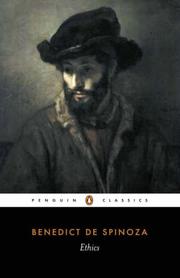
《伦理学》,全称《以几何顺序证明的伦理学》(拉丁语:Ethica, ordine geometryo Demonstrata),是哲学家巴鲁赫·斯宾诺莎用拉丁语写成的哲学论文。 它创作于1661年至1675年之间,并于1677年在斯宾诺莎死后首次出版。
此书有别于其他哲学论文的最大特色,在于它是首位将欧几里得《几何原本》中使用的数学推论方法应用於哲学上。他通过少量定义和公理,试图从中推导出数百个命题和推论,例如“当心灵想像自己缺乏力量时,它会为此感到悲伤”,“一个自由的人想到的只有死亡”,“人的心灵不会被身体的消失而被完全摧毁,它仍然存在一些永恒的东西”。
以上文字摘自维基百科「伦理学 (斯宾诺莎)」(去掉了参考文献等尾部小节),按 CC BY-SA 4.0 使用,作者为维基百科的各位编者。
中文维基百科的条目比较短,下面附上英文维基百科的内容(英文原文):
Ethics, Demonstrated in Geometrical Order (Latin: Ethica, ordine geometrico demonstrata) is a philosophical treatise written in Latin by Baruch Spinoza (Benedictus de Spinoza). It was written between 1661 and 1675 and was first published posthumously in 1677.
The Ethics is perhaps the most ambitious attempt to apply Euclid's method in philosophy, which was referred to as “more geometrico” which in Latin meant “in a geometrical manner”. Spinoza puts forward a small number of definitions and axioms from which he attempts to derive hundreds of propositions and corollaries, such as "when the Mind imagines its own lack of power, it is saddened by it", "a free man thinks of nothing less than of death", and "the human Mind cannot be absolutely destroyed with the Body, but something of it remains which is eternal."
Summary
Part I: Of God
The first part of the book addresses the relationship between God and the universe. Spinoza was engaging with a tradition that held that God exists outside of the universe, that God created the universe for a reason, and that God could have created a different universe according to his will. Spinoza denies each point. According to Spinoza, God is the natural world. Spinoza concludes that God is the substance comprising the universe; that God exists in itself, not outside of the universe; and that the universe exists as it does from necessity, not because of an anthropomorphic reason or will.
Spinoza argues through propositions. He considers the conclusions he reaches to be the necessary logical result of combining the Definitions and Axioms he provides. He starts with the proposition that "there cannot exist in the universe two or more substances having the same nature or attribute." He then argues that objects and events must not merely be caused if they occur, but that they must be prevented if they do not. If something is non-contradictory, there is no reason that it should not exist. Spinoza builds from these starting ideas. If substance exists it must be infinite, because if it is not infinite another finite substance would have to exist to take up the remaining parts of its finite attributes, something that is impossible according to an earlier proposition. Spinoza then uses the Ontological Argument as the justification for the existence of God and argues that God must possess all attributes infinitely. Since no two things can share attributes, "besides God no substance can be granted or conceived."
As with many of Spinoza's claims, what this means is a matter of dispute. Spinoza claims that the things that make up the universe, including human beings, are God's "modes". This means that everything is, in some sense, dependent upon God. The nature of this dependence is disputed. Some scholars say that the modes are properties of God in the traditional sense. Others say that modes are effects of God. Either way, the modes are also logically dependent on God's essence, in this sense: everything that happens follows from the nature of God, just as it follows from the nature of a triangle that the sum of its angles are equal to two right angles or 180 degrees. Since God had to exist with the nature that he has, nothing that has happened could have been avoided; and, if God has fixed a particular fate for a particular mode, there is no escaping it. As Spinoza puts it, "A thing which has been determined by God to produce an effect cannot render itself undetermined."
以上文字摘自英文维基百科「Spinoza's Ethics」(有删节,去掉了参考文献等尾部小节),按 CC BY-SA 4.0 使用,作者为维基百科的各位编者。
资料卡
- 原作语言
- 新拉丁语
- 首次出版
- 1677 年
- 主题
- 伦理学
资料卡来自 Wikidata Q862816(CC0),众包数据,个别字段可能不全。