书单
百科
这个词条暂时没有中文维基百科条目,下面是英文维基百科的内容(英文原文):
Perceptrons: An Introduction to Computational Geometry is a book written by Marvin Minsky and Seymour Papert and published in 1969. An edition with handwritten corrections and additions was released in the early 1970s. An expanded edition was further published in 1988 (ISBN 9780262631112) after the revival of neural networks, containing a chapter dedicated to countering the criticisms made of it in the 1980s.
The main subject of the book is the perceptron, a type of artificial neural network developed in the late 1950s and early 1960s. The book was dedicated to psychologist Frank Rosenblatt, who in 1957 had published the first model of a "Perceptron". Rosenblatt and Minsky knew each other since adolescence, having studied with a one-year difference at the Bronx High School of Science. They became at one point central figures of a debate inside the AI research community, and are known to have promoted loud discussions in conferences, yet remained friendly.
This book is the center of a long-standing controversy in the study of artificial intelligence. It is claimed that pessimistic predictions made by the authors were responsible for a change in the direction of research in AI, concentrating efforts on so-called "symbolic" systems, a line of research that petered out and contributed to the so-called AI winter of the 1980s, when AI's promise was not realized.
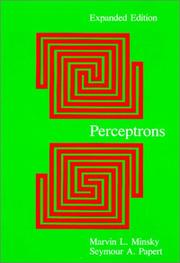
The crux of Perceptrons is a number of mathematical proofs which acknowledge some of the perceptrons' strengths while also showing major limitations. The most important one is related to the computation of some predicates, such as the XOR function, and also the important connectedness predicate. The problem of connectedness is illustrated at the awkwardly colored cover of the book, intended to show how humans themselves have difficulties in computing this predicate. One reviewer, Earl Hunt, noted that the XOR function is difficult for humans to acquire as well during concept learning experiments.
Publication history
When Papert arrived at MIT in 1963, Minsky and Papert decided to write a theoretical account of the limitations of perceptrons. It took until 1969 for them to finish solving the mathematical problems that unexpectedly turned up as they wrote. The first edition was printed in 1969. Handwritten alterations were made by the authors for the second printing in 1972. The handwritten notes include some references to the reviews of the first edition.
An "expanded edition" was published in 1988, which adds a prologue and an epilogue to discuss the revival of neural networks in the 1980s, but no new scientific results. In 2017, the expanded edition was reprinted, with a foreword by Léon Bottou that discusses the book from the perspective of someone working in deep learning.
Background
The perceptron is a neural net developed by psychologist Frank Rosenblatt in 1958 and is one of the most famous machines of its period. In 1960, Rosenblatt and colleagues were able to show that the perceptron could in finitely many training cycles learn any task that its parameters could embody. The perceptron convergence theorem was proved for single-layer neural nets.
During this period, neural net research was a major approach to the brain-machine issue that had been taken by a significant number of persons. Reports by the New York Times and statements by Rosenblatt claimed that neural nets would soon be able to see images, beat humans at chess, and reproduce. At the same time, other new approaches including symbolic AI emerged. Different groups found themselves competing for funding and people, and their demand for computing power far outpaced the available supply.
Contents
Perceptrons: An Introduction to Computational Geometry is a book of thirteen chapters grouped into three sections. Chapters 1–10 present the authors' perceptron theory through proofs, Chapter 11 involves learning, Chapter 12 treats linear separation problems, and Chapter 13 discusses some of the authors' thoughts on simple and multilayer perceptrons and pattern recognition.
Definition of perceptron
Minsky and Papert took as their subject the abstract versions of a class of learning devices which they called perceptrons, "in recognition of the pioneer work of Frank Rosenblatt". These perceptrons were modified forms of the perceptrons introduced by Rosenblatt in 1958. They consisted of a retina, a single layer of input functions and a single output.
Besides this, the authors restricted the "order", or maximum number of incoming connections, of their perceptrons. Sociologist Mikel Olazaran explains that Minsky and Papert "maintained that the interest of neural computing came from the fact that it was a parallel combination of local information", which, in order to be effective, had to be a simple computation. To the authors, this implied that "each association unit could receive connections only from a small part of the input area". Minsky and Papert called this concept "conjunctive localness".
Parity and connectedness
Two main examples analyzed by the authors were parity and connectedness. Parity involves determining whether the number of activated inputs in the input retina is odd or even, and connectedness refers to the figure-ground problem. Minsky and Papert proved that the single-layer perceptron could not compute parity under the condition of conjunctive localness (Theorem 3.1.1), and showed that the order required for a perceptron to compute connectivity grew with the input size (Theorem 5.5).
以上文字摘自英文维基百科「Perceptrons (book)」(有删节,去掉了参考文献等尾部小节),按 CC BY-SA 4.0 使用,作者为维基百科的各位编者。
资料卡
- 原题
- Perceptrons
- 原作语言
- 英语
- 首次出版
- 1969 年
- 主题
- 感知机
资料卡来自 Wikidata Q4359403(CC0),众包数据,个别字段可能不全。